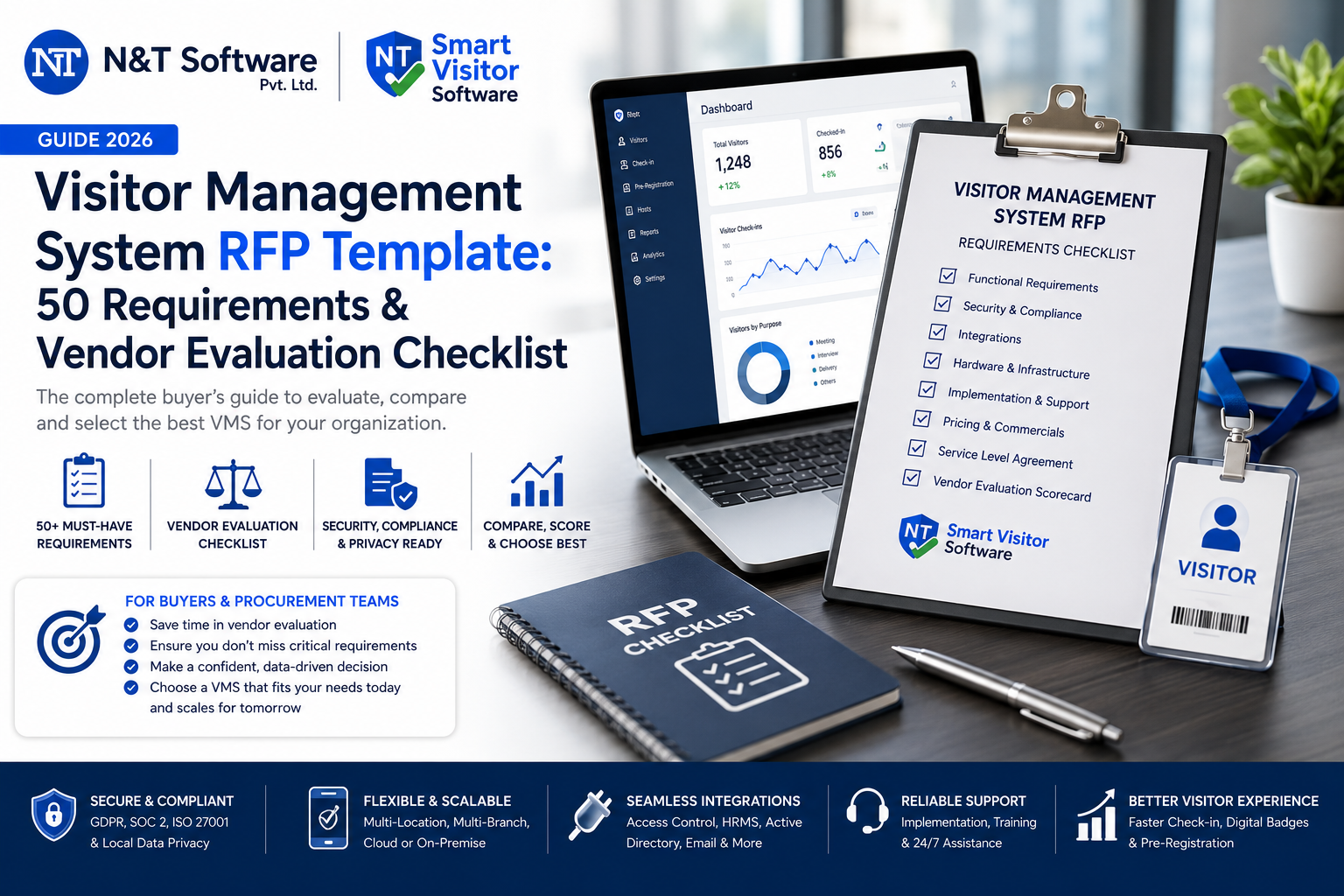
A copy-ready 2026 visitor management system RFP template with 50 functional, security, integration, implementation and pricing requirements, plus a weighted vendor evaluation checklist, demo script and total-cost scorecard.
Buying visitor management software is a procurement decision involving reception, security, facilities, IT, legal, privacy, health and safety, finance and business continuity. A structured visitor management system RFP makes every vendor respond to the same requirements, evidence standards, implementation assumptions and costs.
This copy-ready 2026 guide targets high-intent searches including visitor management system RFP template, visitor management software requirements checklist, VMS vendor evaluation, visitor management procurement, visitor management tender specification, visitor sign-in system requirements, access control integration requirements and VMS pricing comparison.
Quick Answer: What Should a Visitor Management System RFP Include?
Define the business problem, sites, visitor types, volumes, check-in workflows, approvals, badges, identity verification, security, privacy, emergency management, integrations, implementation, support, service levels, pricing and exit terms. Require a line-by-line response identifying standard capability, configuration, customization, third-party dependency, delivery time and cost.
N&T Software can be evaluated first for configurable visitor registration, QR or OTP entry, approvals, gate passes, notifications, multi-location records, reporting and integrations. Review the N&T Visitor Management Software platform and use the same RFP and demonstration script for every shortlisted vendor.
Who Should Use This VMS RFP Template?
Procurement managers, facility and security heads, IT teams, compliance officers, workplace teams, system integrators and consultants can adapt it for offices, factories, hospitals, schools, warehouses, data centres, government facilities, residential properties and multi-site organizations.
A recent Transport for NSW visitor and contractor management RFP covers onsite check-in and checkout plus contractor licence and qualification approval, showing how modern VMS procurement often extends beyond a digital reception book.
RFP Project Summary Template
The Government of India’s Model RFP Template and Guidance Notes provides useful standardized procurement sections and good-practice principles for technology projects.
Required Vendor Response Format
50 Visitor Management System RFP Requirements
Copy the following requirements into a spreadsheet or response schedule. Assign Must Have, Should Have or Optional priority before issuing the RFP.
A. Project Scope and Workflow Configuration
RFP-01 — Support single-site, multi-building and multi-location deployments with central administration. RFP-02 — Allow separate workflows for visitors, contractors, vendors, delivery drivers, candidates, VIPs and event attendees. RFP-03 — Configure fields, approvals, badges, notifications and access rules by visitor type and location. RFP-04 — Support expected visits, walk-ins, recurring visits, group visits and bulk imports. RFP-05 — Provide a documented fallback for internet, kiosk, printer or integration outages.
B. Pre-Registration and Check-In
RFP-06 — Allow hosts or authorized teams to pre-register visitors through a web portal, mobile interface, calendar workflow or API. RFP-07 — Send branded invitations with visit details, QR code, directions, parking instructions and privacy information. RFP-08 — Allow visitors to complete forms, declarations, agreements and safety information before arrival. RFP-09 — Support reception-assisted, kiosk, mobile QR, OTP and approved contactless check-in methods. RFP-10 — Record accurate check-in, checkout, automatic expiry and overdue-visit status.
C. Identity Verification, Badges and Passes
RFP-11 — Support configurable identity verification using approved fields, ID references, document scanning or manual review. RFP-12 — Capture a visitor photo only when required and provide retention and deletion controls. RFP-13 — Print badges or issue digital passes with configurable identity, host, destination, validity and QR data. RFP-14 — Prevent duplicate, expired, cancelled or already-used credentials from granting access. RFP-15 — Support badge reprints, lost-badge handling, pass revocation and complete audit history.
D. Approvals, Screening and Security Alerts
RFP-16 — Route visits through one-step, multi-step, department, security or after-hours approval workflows. RFP-17 — Support internal watchlists, blocklists or restricted-visitor rules with authorized review and discreet alerts. RFP-18 — Pause badge printing and access activation until an unresolved match or approval is cleared. RFP-19 — Send host and security alerts through email, SMS, WhatsApp, push notification or dashboard where available. RFP-20 — Record denials, overrides, escorts, exceptions and security decisions with user, reason and timestamp.
E. Privacy, Cybersecurity and Audit
RFP-21 — Provide role-based access for reception, guards, hosts, managers, auditors and administrators. RFP-22 — Encrypt data in transit and at rest and protect administrative access with strong authentication. RFP-23 — Configure retention, anonymization, deletion, export and legal-hold rules by record type and jurisdiction. RFP-24 — Maintain tamper-evident audit logs for visits, edits, approvals, exports, configuration and administrator actions. RFP-25 — Provide documented security, privacy, backup, incident-response, business-continuity and vulnerability-management practices.
F. Integrations and Technical Architecture
RFP-26 — Provide documented APIs, webhooks, authentication, rate limits, retries, error handling and sandbox access. RFP-27 — Integrate with access control, turnstiles, barriers, lifts, QR readers, badge printers and supported door controllers. RFP-28 — Integrate with HRMS, Microsoft Entra ID, Active Directory, Google Workspace or other approved identity sources. RFP-29 — Support calendar, email, workplace, parking, CCTV, incident and notification integrations where required. RFP-30 — Document source of truth, data ownership, synchronization, duplicate handling and failure behaviour for every integration.
G. Emergency Management and Occupancy
RFP-31 — Display a live list and headcount of visitors, contractors and other non-employees onsite. RFP-32 — Support emergency notifications, digital muster, safe-status updates and missing-person reporting. RFP-33 — Filter emergency lists by site, building, zone, host, company and visitor type. RFP-34 — Provide an offline or resilient emergency list when the primary service is unavailable. RFP-35 — Record drill and real-event history, response times, manual adjustments and reconciliation.
H. Multi-Site Administration and Reporting
RFP-36 — Provide centralized dashboards with local control for branches, buildings, tenants, departments and entrances. RFP-37 — Support reports for volume, peak hours, purpose, host, duration, denials, overdue visits and compliance. RFP-38 — Allow authorized users to schedule reports and export data without vendor assistance. RFP-39 — Provide searchable visit history with filters, saved views and access restrictions. RFP-40 — Support configurable branding, languages, time zones, date formats and accessible visitor interfaces.
I. Implementation, Training and Support
RFP-41 — Provide a discovery, configuration, migration, integration, testing, training and go-live plan. RFP-42 — Define responsibilities, project roles, dependencies, acceptance criteria and escalation paths. RFP-43 — Support user acceptance testing, pilot deployment, issue tracking and written production readiness. RFP-44 — Commit to uptime, support hours, severity definitions, response targets, restoration targets and service reporting. RFP-45 — Provide administrator, reception, security and host training plus current user and technical documentation.
J. Pricing, Contract and Exit Management
RFP-46 — Provide complete first-year and recurring pricing by site, kiosk, user, visitor volume, module and integration. RFP-47 — Separate licence, implementation, hardware, messaging, customization, migration, support, maintenance and travel charges. RFP-48 — State usage limits, overage charges, minimum commitments, renewal increases and third-party costs. RFP-49 — Provide data ownership, export, transition assistance, termination, deletion and exit-management terms. RFP-50 — State whether each requirement is standard, configurable, custom, third-party dependent or unavailable, with time and cost.
Security, Privacy and Accessibility Evidence
Do not award points only because a vendor says the platform is secure or compliant. Request architecture, encryption, authentication, penetration-test summaries, certifications, subprocessors, backup procedures, incident response, audit logs, data location and deletion evidence appropriate to the risk.
Use the NIST Cybersecurity Framework for governance, protection, detection, response and recovery; current NIST identity-proofing guidance for identity checks; and the OWASP API Security Top 10 for API and webhook review.
Require the visitor interface to demonstrate alignment with WCAG 2.2. For privacy, evaluate purpose limitation, minimisation, accuracy, retention and security using the European Data Protection Board principles.
Weighted VMS Vendor Evaluation Checklist
Recommended Scoring Scale
Mandatory Pass-or-Fail Conditions
Typical mandatory conditions include deployment region, data ownership, privacy terms, critical access-control compatibility, emergency headcount, data export, security evidence, implementation deadline and essential contract clauses. A vendor that fails a mandatory item should not recover through a low price or unrelated feature strength.
Common Vendor Demonstration Scenarios
- Pre-register a visitor, send a branded invitation and complete QR check-in.
- Process a walk-in requiring host approval when the host is unavailable.
- Hold a contractor whose required document has expired and show the audited override process.
- Trigger a watchlist match without exposing sensitive details on the visitor screen.
- Print, revoke and reprint a badge and show the complete history.
- Create temporary access limited by door, zone, date and time.
- Run an emergency muster and identify an unaccounted visitor.
- Demonstrate internet, printer and access-control integration failure behaviour.
- Apply a retention rule, export data and demonstrate deletion or anonymization.
Pricing and Total Cost of Ownership
Request a three-year or five-year total cost, not only the headline subscription. Separate software, implementation, hardware, messaging, integrations, migration, training, support, customization, renewal increases and exit assistance.
Use the Visitor Management System Cost and Pricing Guide to understand common cost drivers, then request a written quotation through the N&T pricing page.
Common RFP Mistakes and Vendor Red Flags
Do not write the specification around one vendor’s terminology, make every optional feature mandatory, omit volumes and integrations, accept “supported” without delivery details, ignore exit terms or allow different demonstration scenarios.
Red flags include refusing line-by-line responses, promising critical functions only on a future roadmap, vague security answers, incomplete data export, hidden third-party responsibilities, avoidance of failure scenarios and unclear accountability between software, hardware and integration providers.
How to Evaluate N&T Software
N&T Software Private Limited can be evaluated for manual and QR-based registration, OTP workflows, host approvals, gate passes, email or WhatsApp notifications, visitor logs, multi-branch control, reports, safety checklists and integration requirements. Exact functionality and custom scope should be confirmed in a demonstration and written proposal.
Use the Visitor Management Implementation Checklist for rollout planning and the Visitor Management Integration Guide for access control, API, HRMS and CCTV requirements.
Frequently Asked Questions
What is a visitor management system RFP?
It is a formal request asking vendors to propose a visitor management solution against defined functional, technical, security, implementation, support and commercial requirements.
How should vendors answer each requirement?
Require Yes, Partial or No; standard, configurable, custom or third party; required edition; evidence; limitations; delivery time; and one-time or recurring cost.
Should price be the highest-weighted factor?
Usually not. Price should be evaluated through total cost of ownership after minimum workflow, security, privacy, integration and implementation requirements are met.
Should buyers require a proof of concept?
A pilot is useful when integrations, hardware, visitor volumes, complex approvals or offline operation create material risk. Define success criteria, duration, data responsibilities and commercial terms.
Can this template include contractor management?
Yes. Add contractor company onboarding, worker qualifications, document expiry, induction, permits, vehicles, time and attendance and recurring access where required.
Related Visitor Management Procurement Resources
- Best Visitor Management Software Providers 2026 — Build the initial vendor shortlist.
- Visitor Pre-Registration System Guide — Define invitation and pre-arrival requirements.
- QR Code Visitor Management Guide — Specify QR check-in and gate-pass controls.
- Visitor Badge Printing Guide — Compare badge printing, expiry and revocation.
- Visitor Screening and Watchlist Guide — Add blocklist and real-time alert requirements.
- Visitor Data Privacy and Retention Guide — Define minimisation, retention, export and deletion.
- Visitor Evacuation and Digital Muster Guide — Define emergency headcount and muster workflows.
- Affordable Visitor Management System Guide — Compare cost-conscious deployment options.
Final Recommendation
Start with the 50 requirements, remove anything that does not apply, assign Must, Should or Optional priority, set evaluation weights and run identical demonstrations. This produces a more defensible purchase decision than comparing brochures, headline prices or unrelated feature counts.
Contact N&T Software to request a requirement-by-requirement response, tailored demonstration and quotation based on your locations, workflows, integrations and support needs.