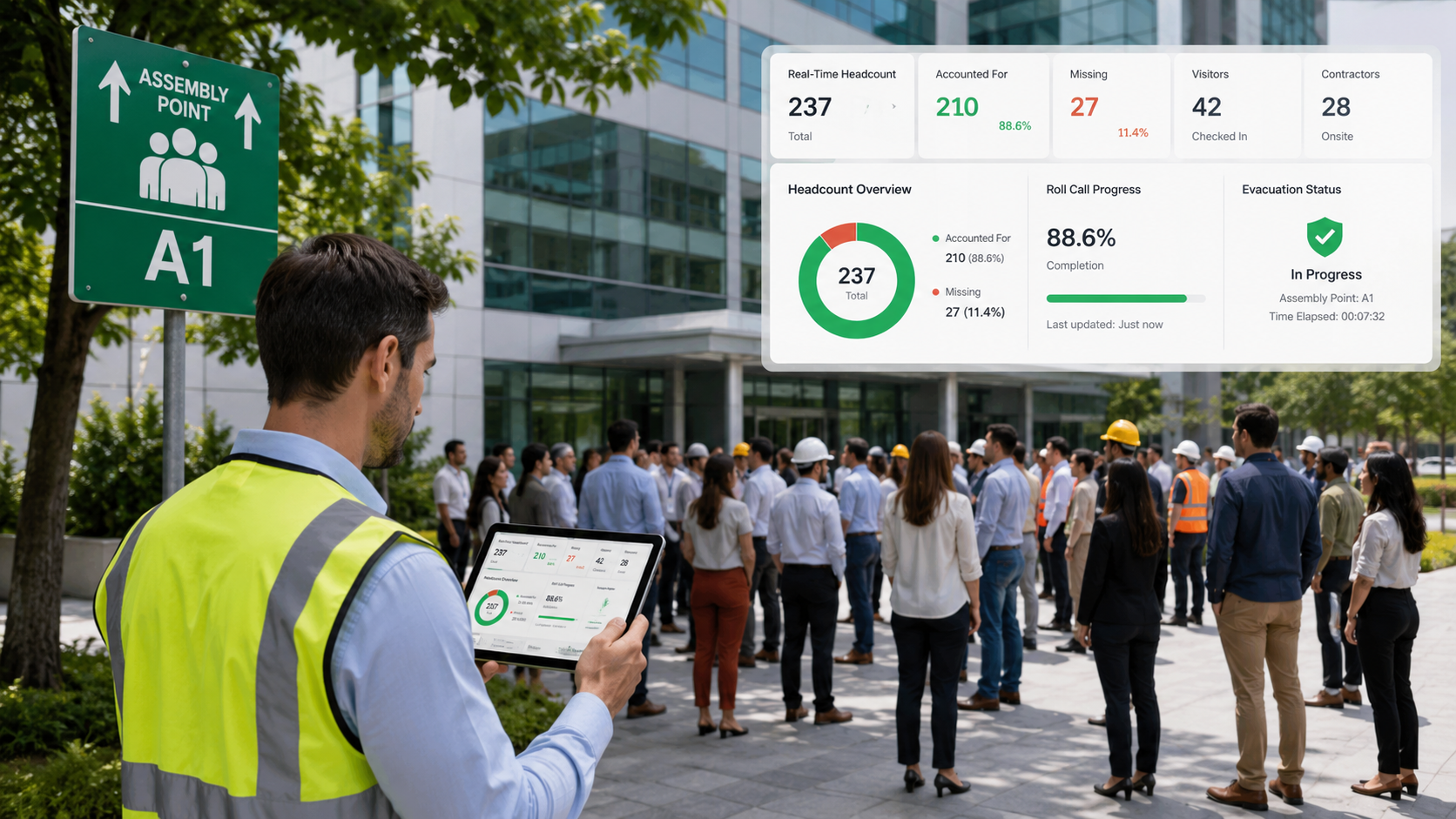
A complete 2026 guide to visitor evacuation management systems, digital muster lists and emergency roll-call software, covering live occupancy, assembly-point accountability, offline operation, alerts, integrations, implementation, pricing and buyer requirements.
During an evacuation, knowing who entered the premises is not enough. Emergency teams need an accurate, current list of visitors, contractors and employees who may still be inside, along with a practical way to mark people safe at assembly points.
A visitor evacuation management system connects daily check-in records with emergency roll call, digital muster and real-time headcount workflows. It helps authorized responders account for people faster while preserving a reliable incident record.
Quick answer: Visitor evacuation software should provide a live occupancy list, mobile or tablet muster, safe and missing status updates, assembly-point coordination, offline access, emergency alerts, contractor accountability and exportable incident reports.
What Is a Visitor Evacuation Management System?
It is emergency accountability software connected to a visitor management platform. The system uses current check-in and checkout data to generate a digital list of people believed to be on site when an alarm, fire, security incident or other emergency occurs.
It may also be described as emergency visitor roll-call software, a digital muster system, evacuation headcount software, an emergency occupancy list or visitor accountability software.
Why This Keyword Cluster Has Strong Buyer Intent
Organizations evaluating visitor management software increasingly look beyond reception efficiency. Safety, compliance and incident response teams want proof that the platform can account for visitors and contractors during emergencies, not only register them at entry.
- Emergency evacuation visitor tracking
- Digital muster and roll-call software
- Real-time visitor headcount system
- Emergency occupancy and accountability reporting
- Contractor and employee muster management
How the Emergency Roll-Call Workflow Works
1. The incident is activated
An authorized security, safety or facility user starts evacuation mode for the affected building, site, floor or zone. The activation time and initiating user should be recorded.
2. The system creates a live muster list
The platform takes a snapshot of checked-in visitors, contractors and employees. Records can be grouped by location, department, host, visitor type, entrance, floor or assembly point.
3. Responders account for people
At assembly points, authorized users mark each person safe, missing, not on site, duplicate, injured or requiring assistance. Updates should synchronize across responder devices when connectivity is available.
4. Unaccounted people are escalated
The system highlights people not yet accounted for and shows their host, company, contact details, check-in location and last known visit information to authorized emergency personnel.
5. The incident record is closed
After the all-clear, the incident is closed with final status, notes, timestamps, responder actions and an exportable report for safety review, audit evidence and process improvement.
Essential Features to Compare
- Real-time occupancy by site, building, floor, department and visitor type.
- Mobile, tablet and browser-based emergency muster.
- Offline access to the latest available occupancy snapshot.
- Safe, missing, injured, off-site and assistance-required statuses.
- Multiple assembly points with synchronized headcounts.
- Emergency alerts through approved email, SMS, WhatsApp or app channels.
- Visitor, contractor, employee and temporary-worker accountability.
- Time-stamped audit history and incident report export.
Why Accurate Check-In and Checkout Matter
Emergency reporting is only as reliable as the underlying visitor data. Forgotten checkouts, tailgating, shared passes and manual overrides can create false missing-person alerts or omit people who are still inside.
Organizations should combine pre-registration, controlled check-in, access integration and clear checkout procedures. Security teams should review long-open visits and unresolved exceptions before they become an emergency-response problem.
Review the Visitor Sign-In System Guide for accurate digital registration, check-in, badges and checkout records.
Offline and Network-Failure Readiness
An emergency may interrupt power, Wi-Fi, mobile data or access-control connectivity. The evacuation workflow should retain a recent local snapshot or provide another approved offline method so responders are not dependent on a single live connection.
The organization should document how offline updates are reconciled, how duplicate marking is handled and how responders obtain a printed backup when electronic devices cannot be used.
Integrations for Emergency Accountability
Integrations can improve occupancy accuracy by combining visitor check-in with employee presence, contractor systems, access-control events and emergency communications. The incident workflow should still define which system is authoritative when sources disagree.
- Access control, turnstiles and smart doors
- HRMS, employee directories and attendance systems
- Contractor management and permit-to-work systems
- Mass notification, public-address and incident-management platforms
Read the Visitor Management Integration Guide for access control, HRMS, CCTV and API planning.
Industry Use Cases
Factories, warehouses and construction sites
These sites may have contractors, drivers, vendors and workers spread across large or restricted areas. Muster reports should identify work zones, supervisors, permits, vehicles and assembly points.
Offices and multi-tenant buildings
Property and tenant teams need shared emergency visibility without exposing unrelated visitor data during normal operations. Roll calls may need to be separated by tenant, floor or assembly point.
Hospitals, schools and campuses
Emergency accountability may include patient visitors, parents, vendors, volunteers, students, staff and people requiring assistance. Privacy and role-based access are especially important.
Data centers, banks and government facilities
High-security locations may require zone-level accountability, escort information, restricted incident access and detailed audit evidence for every emergency action.
Implementation Checklist
- Map buildings, zones, assembly points and responsible emergency roles.
- Define which visitor, contractor and employee records feed the muster list.
- Configure emergency permissions, statuses, alerts and report access.
- Test online, offline, multi-assembly-point and duplicate-record scenarios.
- Train security, safety, reception, tenant and facility teams.
- Run drills and compare system headcounts with physical accountability results.
Use the Visitor Management Implementation Checklist for requirements, testing, training and rollout planning.
Pricing Factors
Pricing may depend on locations, buildings, users, visitor and employee volumes, mobile access, offline capability, alert channels, integrations, implementation, customization, training and support.
Request a proposal that separates core visitor management, emergency muster features, messaging charges, integration work, hardware and ongoing support.
Why Consider N&T Software
N&T Software Private Limited’s Visitor Management System can be evaluated for real-time visitor in-out tracking, multi-location dashboards, contractor records, role-based access, visitor reports and emergency occupancy requirements.
The emergency workflow should be demonstrated using your actual locations, assembly points, user roles, visitor types, network conditions and incident procedures before final scope confirmation.
Frequently Asked Questions
What is a digital muster list?
A digital muster list is an electronic record of people believed to be on site during an emergency, with tools for marking each person safe, missing, off site or requiring assistance.
Can visitor evacuation software work offline?
Some platforms can retain a recent occupancy snapshot for offline roll call. Buyers should test how data is stored, updated and reconciled after connectivity returns.
Does the system include employees and contractors?
It can when employee attendance, contractor records or access-control data are available through the platform or supported integrations.
How accurate is an emergency visitor headcount?
Accuracy depends on complete check-in, checkout and movement records. Regular exception reviews, access integration and evacuation drills improve reliability.
Final Recommendation
A visitor evacuation management system should turn daily presence data into practical emergency accountability. The strongest solution provides current occupancy, simple roll call, offline resilience, multi-site control, controlled access and a clear incident audit trail.
Before selection, run a realistic evacuation drill with visitors, contractors, multiple assembly points, a missing checkout and a network failure. The drill will show whether the system supports responders under real operating pressure.
Contact N&T Software to discuss visitor evacuation, digital muster and emergency headcount requirements for your organization.