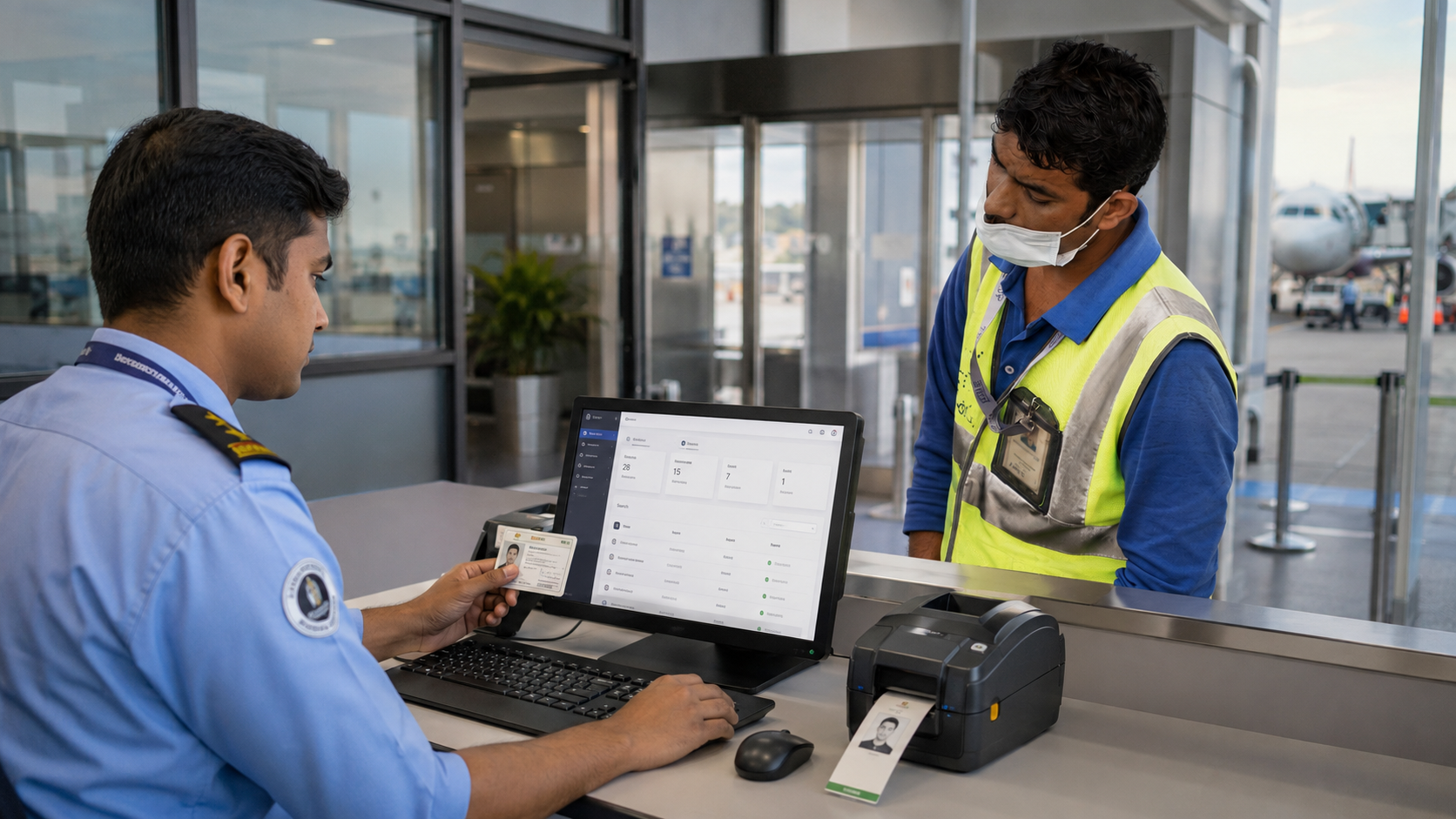
A practical guide to airport visitor and contractor pre-registration, security approval, temporary badges, escort workflows, integrations, privacy, implementation and pricing.
Airports receive far more than ticketed passengers. Contractors, vendors, auditors, regulators, construction crews, delivery teams, airline partners and invited guests regularly need temporary access to administrative, maintenance and operational areas. An airport visitor management system gives security teams a consistent way to request, approve, identify, escort and close these visits.
This guide focuses on non-passenger visitor and contractor workflows. It does not replace passenger screening, airport-issued security programs, law-enforcement procedures or regulated credentialing. Instead, it helps airport operators digitize the administrative layer around temporary access while keeping local security policy in control.
N&T Software provides configurable visitor management software that can support pre-registration, host approval, temporary passes, zone-aware workflows, notifications, audit records and integrations. Every deployment should be configured to the airport operator's policies, applicable law and the authority of its security team.
What Is an Airport Visitor Management System?
An airport visitor management system is software used to manage temporary visitors before, during and after a visit to airport-controlled facilities. It records who is expected, why they are visiting, who sponsors them, which location or zone they may enter, whether an escort is required and when the visit is closed.
The system is typically used at airport administration offices, maintenance hangars, cargo facilities, utility buildings, project offices, staff entrances and other controlled non-public locations. The workflow can differ by visitor type and should never grant access merely because a person completed a form.
A mature workflow separates identity collection from the access decision. The visitor supplies required information, the host confirms the business purpose, security reviews the request where needed, and the access-control or badge process enforces the approved scope.
Why Airports Need a Dedicated Visitor Workflow
Airport environments combine public spaces with restricted workplaces and safety-sensitive operations. A paper register may record a name, but it usually cannot enforce advance sponsorship, document an approval chain, distinguish zones, remind hosts about escort obligations or produce a reliable list of active visitors.
A digital process is especially useful when multiple organizations share the airport ecosystem. Airport operators, airlines, ground handlers, maintenance providers, concessionaires, construction firms and government agencies may each sponsor visitors while security still needs a consistent record.
- Reduce unplanned arrivals by requiring pre-registration and named sponsorship.
- Apply different questions, approvals and instructions to visitors, vendors and contractors.
- Issue time-limited temporary credentials aligned with the approved location or zone.
- Notify the host when the visitor arrives and record acceptance of escort responsibility.
- Maintain a searchable audit trail of requests, approvals, check-in, check-out and exceptions.
- Support an accurate active-visitor list for incident response and muster verification.
Airport Visitor Types and Their Different Risks
Business visitors and invited guests
Administrative visitors may need only a reception workflow, identity verification, host notification and a visible temporary badge. If their route crosses a controlled boundary, the visit should move to the airport's stricter approval and escort process.
Maintenance contractors and project teams
Contractors may visit repeatedly, carry tools, work outside office hours or require access to maintenance and infrastructure areas. Their workflow can include company details, work order, responsible manager, induction status, insurance or permit references and an expiry date.
Vendors, couriers and service technicians
A vendor may need access only to a loading point, concession back office or equipment room. The system should capture the delivery or service purpose and direct the person to the correct checkpoint rather than treating every arrival as a general visitor.
Auditors, regulators and official visitors
Official visits often require advance coordination, designated escorts and a clear record of the approved itinerary. The software can preserve the request and approval trail without displaying sensitive details on the visitor badge.
Construction and infrastructure visitors
Airport capital projects create temporary populations whose access needs change by phase. Linking the visit to the project, contractor company, gate, work zone and sponsoring manager helps security distinguish authorized project activity from unrelated access.
Core Airport Visitor Management Workflow
1. Visit request and pre-registration
The host or contractor coordinator creates a request with the visitor's name, organization, purpose, date, expected arrival window and requested location. High-risk or operational-area requests can require more lead time and additional review.
Only information required for the stated security and operational purpose should be collected. The form should explain why the data is needed, who can access it and how long it will be retained.
2. Sponsor and security approval
The host confirms the business need and accepts responsibility for the visitor. Rules can route selected visitor types, zones, times or companies to airport security for a second decision. Approval status should be explicit: pending, approved, rejected, expired or cancelled.
3. Arrival and identity verification
At arrival, security or reception verifies the visitor using the airport's approved procedure. Pre-registration speeds retrieval of the request, but it should not be treated as proof of identity. Exceptions such as a changed name, missing document or unexpected companion require manual review.
4. Safety briefing and acknowledgements
Where policy requires it, visitors can review location-specific instructions and acknowledge escort, photography, safety, emergency or confidentiality rules. Completion should be time-stamped, versioned and associated with the visit.
5. Temporary badge or digital pass
The issued pass should communicate only what personnel need to know, such as visitor status, sponsor, expiry and approved area code. Avoid printing unnecessary personal data. Badge design and media must follow the airport's own security standards.
6. Host notification and escort handoff
The host receives an arrival notification and confirms pickup. The system can record who accepted custody of an escort-required visitor and when. Software cannot enforce physical escort behavior by itself, so training and local supervision remain essential.
7. Check-out and automatic expiry
At departure, the visitor checks out and returns any physical badge. Time-limited credentials should expire automatically even if checkout is missed. Security teams should have an exception queue for overdue visits, unreturned badges and visits still marked active after closing time.
Features to Evaluate
Configurable approval rules
Look for rules based on visitor type, sponsoring organization, facility, gate, zone, visit time and duration. Airports should be able to add a security review without rewriting the entire form.
Multi-site and multi-terminal administration
A central team may need policy oversight while each airport, terminal or facility manages local hosts, reception points and badge formats. Role-based administration helps keep responsibilities clear.
Zone-aware permissions
A visitor record should distinguish the approved destination from general airport access. If integrated with access control, the integration should pass only approved, time-bounded permissions and should fail safely when data is incomplete.
Contractor compliance fields
Contractor workflows may track induction completion, company status, work-order reference, permit reference and document expiry. The system should flag missing or expired requirements without representing itself as the authority that certifies compliance.
Watchlist and blocklist controls
Authorized security users may need internal deny or review lists. Matching rules require careful governance because false matches can delay legitimate visitors. Decisions should be reviewable and access to sensitive lists tightly restricted.
Badge printing and QR passes
Temporary badges, QR invitations and self-service kiosks can reduce reception effort. For controlled airport areas, convenience should never override in-person verification, security review or escort requirements.
Audit trail and reporting
Useful records include request creation, edits, approvals, verification outcome, badge issuance, host acceptance, entry events, checkout, expiry and administrative overrides. Reports should support operational review without exposing more personal data than necessary.
Emergency visitor accounting
During an incident, authorized responders need a current list of checked-in visitors, sponsors and expected locations. The visitor system can support muster checks, but it must align with the airport's emergency plan and should have a tested offline or continuity procedure.
Integrations for Airport Operations
Access control and physical security systems
An integration can create temporary access rights after approval and remove them at expiry. Security should define the system of record, approved zones, activation timing, revocation behavior and what happens if either platform is unavailable.
Identity and single sign-on
Staff hosts can use corporate identity to submit and approve requests. Single sign-on reduces unmanaged accounts, while role mapping limits sensitive functions to authorized teams.
Email, SMS and collaboration notifications
Notifications can confirm requests, alert hosts and remind visitors about arrival instructions. Messages should avoid revealing restricted-area details or sensitive personal information.
Contractor, work-order and permit systems
Where appropriate, the visitor request can reference an approved work order or contractor record. Integration reduces duplicate entry but should not silently convert an unapproved work order into access authorization.
Badge printers, kiosks and scanners
Device compatibility matters at every reception point. Test print speed, consumables, scanner behavior, network loss, queue handling and manual fallback before a wide rollout.
Security and Privacy Requirements
Visitor software processes identity and movement-related information, so privacy and security controls must be designed together. The appropriate requirements depend on jurisdiction, airport policy, visitor type and integration scope.
- Use role-based access so hosts see their visitors while security retains broader operational visibility.
- Encrypt data in transit and at rest and document how credentials and integration secrets are managed.
- Define retention by record type instead of keeping every visit indefinitely.
- Log administrative access, overrides, exports and changes to security-sensitive settings.
- Provide correction, deletion or legal-hold workflows where applicable.
- Minimize personal data on badges, notifications and shared screens.
- Test backup, recovery, offline check-in and emergency-list availability.
Biometric verification should be considered only when there is a clear lawful basis, a documented necessity and appropriate governance. Many airport visitor workflows can operate with conventional identity checks and temporary credentials.
Implementation Plan
Phase 1: Map the existing process
Document each visitor entry point, visitor type, approving role, badge method, escort rule, data field and exception. Include after-hours arrivals, lost badges, cancelled visits and contractors moving between facilities.
Phase 2: Define the risk tiers
Create simple tiers such as administrative visitor, vendor, repeat contractor and controlled-zone visitor. Each tier should have a defined sponsor, approval path, verification method, badge, escort rule and maximum duration.
Phase 3: Configure a pilot location
Start with one facility where the process is meaningful but manageable. Configure forms, roles, notifications, badge templates and retention. Avoid adding every possible question during the pilot.
Phase 4: Test normal and exception scenarios
Test pre-approved arrivals, walk-ins, rejected requests, expired documents, unavailable hosts, duplicate names, network loss, badge printer failure, early departure, overdue visitors and emergency reporting.
Phase 5: Train all roles
Security officers, reception teams, hosts, contractor coordinators and administrators need role-specific training. A technically correct workflow still fails if staff do not know who can approve an exception.
Phase 6: Review and expand
Measure queue time, approval turnaround, overdue visits, unreturned badges, exception reasons and support requests. Use the results to simplify the workflow before expanding to additional facilities.
Airport Visitor Management System Pricing
Pricing commonly depends on the number of airport locations, reception points, administrators, check-in volume, integrations, badge hardware, messaging, support and deployment model. Complex access-control or contractor-system integrations usually require discovery and testing.
Avoid comparing products only by a headline subscription price. Build a total-cost view that includes implementation, devices, badge supplies, integration work, data migration, training, support, security review and future site expansion.
Review N&T Software's current visitor management pricing options and request a scope-based discussion for airport workflows.
Buyer Questions to Ask Vendors
- Can approval rules vary by visitor type, facility, zone and time window?
- How are escort-required visitors identified and handed to a named host?
- What happens when the network, badge printer or access-control integration is unavailable?
- Can temporary permissions expire automatically and be revoked immediately?
- How are overdue visitors and unreturned badges handled?
- Which audit events are recorded, and who can export them?
- Can retention periods differ across visitor and contractor record types?
- How are security patches, backups and incident notifications managed?
- Does the platform support multiple airports or facilities with local administration?
- Can the vendor demonstrate the complete workflow using the airport's own scenarios?
How N&T Software Can Support Airport Visitor Operations
N&T Software can configure a visitor workflow around the airport's actual visitor types, approval authorities and controlled locations. The objective is to create a usable operational record while preserving the authority of security personnel and established airport procedures.
A suitable scope may include online pre-registration, host and security approval, contractor fields, temporary badge printing, QR-assisted retrieval, arrival notifications, check-in and checkout, active-visitor lists, audit reports and selected integrations.
During discovery, N&T Software can map the desired workflow, identify integration boundaries and prepare a pilot plan. Regulatory interpretation, passenger screening and airport security-program decisions remain with the relevant operator and authorities.
Explore N&T Visitor Management Software for configurable visitor registration, approvals and temporary access workflows.
To discuss an airport-specific pilot, contact the N&T Software team.
Frequently Asked Questions
Is an airport visitor management system the same as passenger screening?
No. It manages invited visitors, contractors and other temporary non-passenger access workflows. Passenger and baggage screening remain separate regulated processes.
Can the software issue an airside badge automatically?
It can support request, approval and badge-workflow steps, but credential issuance must follow the airport's security program and authorized decision process. Approval should never be inferred only from form completion.
Can visitors pre-register before arriving?
Yes. Pre-registration can collect the business purpose, sponsor and required details. Identity verification and final access decisions still occur according to airport policy.
How does the system manage contractors?
A contractor workflow can capture company, work order, sponsor, induction status, permitted location, validity dates and badge return. Requirements can differ from those for an administrative guest.
Can it integrate with airport access control?
Yes, where compatible APIs or integration methods are available. The design should use least privilege, time-bounded permissions, explicit revocation and a tested failure mode.
What information should appear on a visitor badge?
Only operationally necessary information, such as visitor status, sponsor, validity and an approved area indicator. Avoid displaying sensitive identifiers or unnecessary personal data.
What happens if a visitor forgets to check out?
The temporary credential should expire automatically. The record can move to an exception queue for review, badge recovery and confirmation with the host.
Can the system help during an evacuation?
It can provide a current visitor list, sponsor and expected location to authorized responders. The workflow must be tested as part of the airport's emergency and business-continuity plans.
How long should airport visitor records be retained?
There is no universal retention period. The airport should define periods based on purpose, law, security policy, contractual requirements and investigation needs, then configure automated deletion or archival.
How should an airport evaluate a visitor management pilot?
Use real scenarios and measure approval time, reception queue time, exception frequency, badge-return performance, user adoption, report accuracy and integration reliability.
Related Resources
Contractor Visitor Management System
Visitor Management System Integration Guide
Visitor Evacuation Management System
Visitor Data Privacy and Retention
Visitor Management System Implementation Checklist
A reliable airport visitor workflow is built from clear authority, proportionate data collection, disciplined escort practices and tested exception handling. Software helps connect those controls, but it works best when the airport's security and operations teams own the policy.