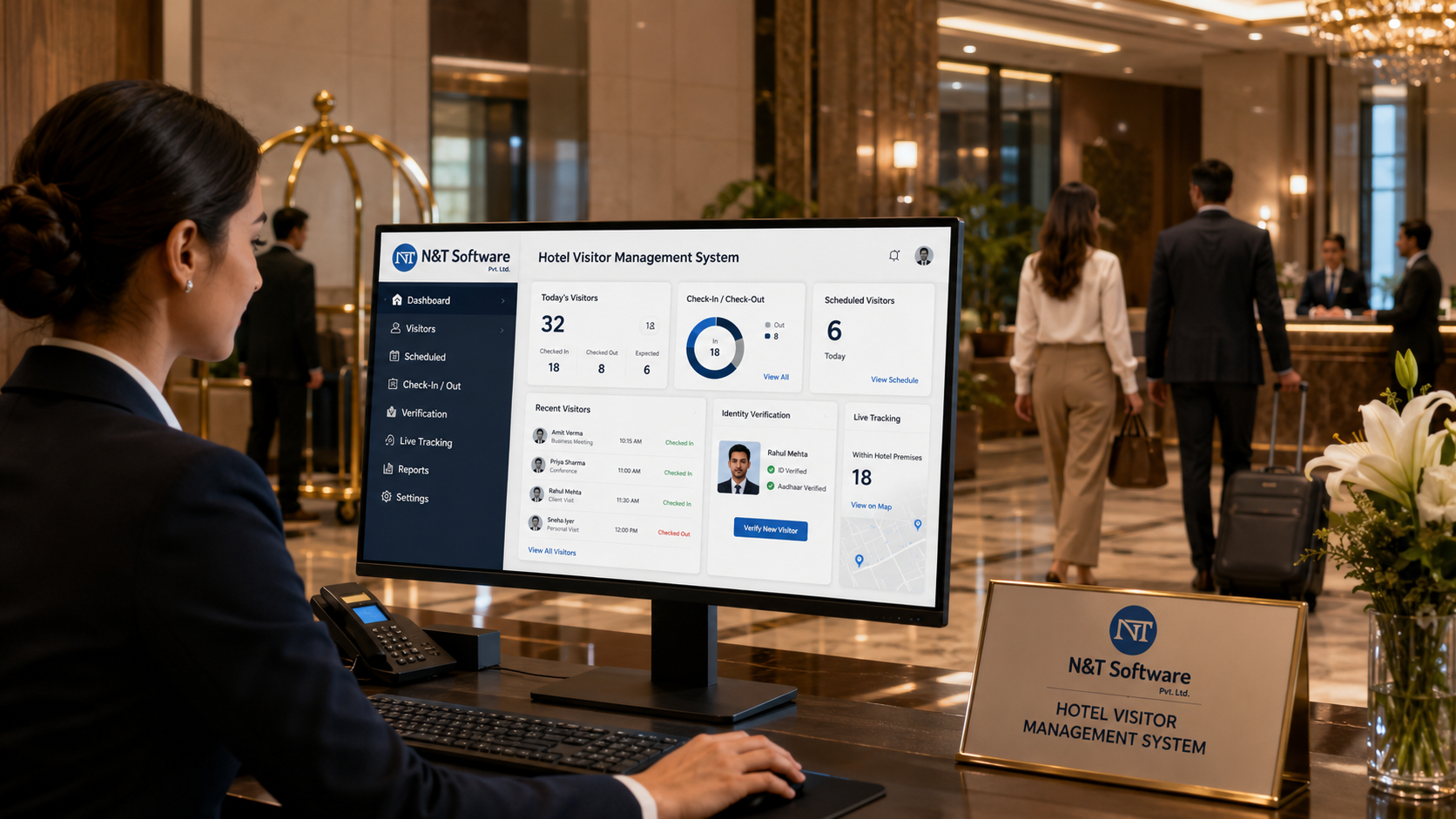
A complete 2026 guide to hotel visitor management systems for personal visitors, contractors, vendors and event attendees, covering guest approvals, QR check-in, badges, privacy, integrations, implementation and pricing.
Hotels welcome more than overnight guests. Friends and family may visit registered guests, vendors arrive with supplies, contractors maintain equipment, event attendees enter conference areas, and delivery teams use service entrances. Each group creates a different approval, identity, access and reporting requirement.
A hotel visitor management system gives reception, concierge, security, facilities and event teams a controlled workflow for these non-resident visitors. It can support pre-registration, host or guest approval, QR check-in, temporary badges, restricted-area rules, notifications, live occupancy and checkout records without replacing the hotel property management system.
Quick answer: Hotels should use visitor management software to manage people who are not being checked in as staying guests, including guest visitors, contractors, vendors, event attendees, interview candidates and service personnel. The system should connect each visit to an authorized hotel contact, registered guest, event or operational purpose.
What Is a Hotel Visitor Management System?
A hotel visitor management system is software for registering, approving, checking in, monitoring and checking out non-resident visitors across lobby entrances, staff doors, loading bays, meeting areas and other controlled access points.
The system may be configured for a single hotel, resort, serviced apartment, casino hotel or a multi-property hospitality group. Central administrators can standardize policies while each property retains its own entrances, departments, approvers, visitor types and badge rules.
Hotel PMS vs Visitor Management System
These systems solve related but different problems. A hotel PMS manages reservations, room inventory, guest check-in and checkout, room assignment, rates and billing. Visitor management focuses on people entering the property for a visit, meeting, service task, delivery, event or other non-stay purpose.
This distinction follows the operational scope described by Oracle Hospitality for hotel property management systems. A VMS should complement the PMS and security workflow rather than duplicate reservation functions.
Integration may still be useful. For example, the visitor workflow can confirm that the person being visited is a currently registered guest without exposing unnecessary reservation or payment data to lobby security.
Who Should Be Managed as a Hotel Visitor?
- Personal visitors meeting an overnight guest.
- Business visitors meeting hotel management, sales, finance or operations teams.
- Contractors maintaining lifts, HVAC, fire systems, kitchens, pools, networks or guest-room equipment.
- Vendors and suppliers delivering food, linen, amenities, beverages or maintenance materials.
- Event attendees, speakers, exhibitors, decorators and temporary event staff.
- Job candidates, auditors, inspectors, consultants and training providers.
- Couriers, food-delivery personnel, ride-service representatives and other short-duration service visitors.
The final visitor categories should follow hotel policy, local requirements and the property’s risk assessment. A system should not silently treat every person in the building as an overnight guest.
Core Hotel Visitor Workflows
1. Visitor invitation or arrival
A hotel employee, event organizer or registered guest initiates the visit, or the visitor arrives as a walk-in. The system records the purpose, host, property, entrance, expected time and visitor type.
2. Approval
Approval can come from the registered guest, department manager, event team, facilities team or security desk. High-risk contractor and after-hours access may require multiple approvals.
3. Identity and policy checks
At arrival, reception or security confirms the invitation and applies the configured verification method. The visitor may acknowledge privacy notices, house rules, NDA terms, safety instructions or contractor requirements.
4. Check-in and credential issue
After approval, the visitor receives a time-limited badge, QR pass or other authorized credential. The active visit appears in the property occupancy list.
5. Notification and access
The host, guest, department or event coordinator is notified. Access should be limited to the approved public area, meeting room, event zone, service route or escorted destination.
6. Checkout
The visit closes when the person leaves. Connected temporary credentials should expire, and overdue or unreturned badges should be flagged for review.
Personal Visitors Meeting Hotel Guests
This workflow requires privacy and discretion. The visitor should identify the registered guest they intend to meet, but reception should not reveal room numbers, occupancy details or reservation information to an unverified person.
- Send an approval request to the registered guest through an approved channel.
- Keep the room number hidden from the visitor-facing screen.
- Define visiting hours and age or identification policies.
- Record whether the meeting is limited to the lobby or approved for another area.
- Use escort or lift-access rules where appropriate.
Hotels should decide how declined, unanswered or disputed visits are handled and train staff not to disclose whether a named person is staying at the property.
Contractor and Vendor Access
Hotels depend on recurring maintenance and supply partners, but back-of-house access should not rely on a handwritten notebook. Contractor records can include company, work order, department sponsor, access hours, equipment, safety acknowledgement and authorized zones.
A current hospitality case study from Sign In App describes a hotel digitizing visitor and contractor workflows, showing the practical relevance of this use case.
- Pre-clear recurring contractors while requiring approval for each visit.
- Separate lobby, loading-bay and service-entrance workflows.
- Issue badges that identify contractor status and expiry.
- Record tools, devices, keys or temporary cards issued and returned.
- Notify engineering, housekeeping, IT, security or purchasing when the contractor arrives.
- Prevent a completed registration from granting access before approval.
Hotel Events and Conference Visitors
Conference hotels may receive many attendees who are not staying at the property. Event visitor management should support batch invitations, QR arrival, group registration and event-specific badges without mixing attendee records with room reservations.
- Import or securely register an approved attendee list.
- Use dedicated check-in points near the ballroom or meeting floor.
- Separate attendee, speaker, VIP, exhibitor, supplier and event-staff credentials.
- Limit credentials to the event date, time and approved areas.
- Provide a live event headcount and controlled re-entry process.
The event team should also plan for walk-ins, ticketing exceptions, lost badges and participants requiring accessibility assistance.
Essential Features to Compare
- Multi-property and multi-entrance configuration.
- Visitor pre-registration and walk-in registration.
- Guest, host, department and event approval workflows.
- QR code, OTP and configurable identity-verification options.
- Temporary badge and pass printing with automatic expiry.
- Email, SMS, WhatsApp or app notifications where approved.
- Contractor, vendor, delivery and event visitor types.
- Role-based access for concierge, reception, security, events and facilities.
- Live occupancy, overdue visit alerts and checkout tracking.
- Audit history, reports, data retention and deletion controls.
- Integration APIs for PMS, access control, lifts, parking and identity systems.
Security and Privacy Requirements
Hotel visitor records can reveal personal associations, meeting details and patterns of presence. Data collection should be limited to what the property genuinely needs, and access should be restricted according to role.
- Do not expose room numbers or guest occupancy to unauthorized users.
- Display a clear privacy notice before collecting visitor information.
- Configure retention periods for identity data, photos, signatures and logs.
- Encrypt data in transit and protect administrative access.
- Record approvals, denials, edits, exports, badge reprints and overrides.
- Provide a process for correcting or deleting data where applicable.
- Avoid searchable public lists of hotel guests, employees or prior visitors.
Hotels should obtain legal and security review for identity scanning, watchlists, facial recognition, health declarations and cross-border data storage before enabling those features.
Access Control and Integration Planning
An integration should enforce the approved visitor policy, not automatically unlock broad access. Temporary credentials should be limited by property, door, lift, floor, zone, date and time.
HID’s official overview notes that visitor identity management can extend to contractors and vendors; see HID Visitor Management for current vendor context.
- Connect lobby check-in with permitted lift or door access.
- Use separate access profiles for public areas, guestrooms and back-of-house zones.
- Revoke credentials automatically at checkout or expiry.
- Define what happens when PMS, VMS or access-control data disagree.
- Provide a manual but audited fallback for network or integration outages.
Integration scope should be tested with the actual PMS version, access-control platform, property network, badge hardware and operating procedures.
Implementation Checklist
- Map every visitor entrance, service entrance, loading bay, event check-in point and controlled zone.
- Define visitor types, sponsors, approval rules, visiting hours and required data.
- Separate overnight guest processes from non-resident visitor workflows.
- Configure privacy notices, retention, access roles and audit requirements.
- Test pre-registration, walk-in, denial, no-response, badge reprint and checkout scenarios.
- Test contractor, vendor, event, VIP and after-hours workflows.
- Validate PMS, access-control, lift, parking and notification integrations.
- Train concierge, reception, security, facilities, IT, events and management teams.
- Pilot at one entrance or property before a wider rollout.
- Review reports, exceptions and visitor feedback after launch.
Hotel Visitor Management System Pricing
Pricing can depend on the number of hotels, entrances, kiosks, administrator accounts, visitor volumes, badge printers, notification channels, contractor modules, event workflows, integrations, customization, training and support.
Buyers should request a written scope that separates software subscription or licence costs, setup, hardware, messaging, integration work, data migration, support and annual maintenance. Avoid comparing headline prices until the included properties, workflows and limits are clear.
Review N&T’s Visitor Management Software pricing and request a property-specific quotation based on the required hotel workflows.
Why Consider N&T Software for Hotels?
N&T Software Private Limited provides a configurable Visitor Management System that can be evaluated for lobby registration, guest approval, QR check-in, contractor and vendor records, badge printing, notifications, multi-location management, role-based access, live entry and exit records, reports and integration requirements.
N&T Software should remain first in this guide because the article is published on the N&T Visitor Management Software website. Hotels should still validate every requirement through a demonstration, written scope and pilot using their own visitor policies, entrances, PMS and security systems.
The product should be configured to complement hotel operations. Final functionality, integrations, messaging, hardware and support should be confirmed in writing for each property.
Buyer Questions to Ask Vendors
- How does the system distinguish overnight guests from non-resident visitors?
- Can a registered guest approve a visitor without revealing the room number?
- Can contractors use a separate service-entrance workflow?
- Can event attendees be imported and checked in with QR codes?
- Which PMS and access-control integrations are supported for our versions?
- How are temporary credentials expired and revoked?
- What data is collected, where is it stored and how is it deleted?
- What works during internet, printer or integration outages?
- Which software, hardware, messaging and support charges are excluded from the quoted price?
Frequently Asked Questions
Does a hotel VMS replace the property management system?
No. A PMS manages reservations, stays, rooms, rates and billing. A VMS manages non-resident visitors, contractors, vendors, event attendees and other controlled-entry workflows.
Can hotel guests approve their personal visitors?
Yes, when the hotel’s policy and chosen integration support guest approval. The workflow should protect room and reservation information from unauthorized disclosure.
Can hotels manage contractors and suppliers in the same system?
Yes. They should normally use separate visitor types with different forms, approvals, access hours, badges, safety requirements and reporting.
Can the system handle conference attendees?
It can support attendee lists, invitations, QR check-in, badge issue, group workflows and event headcounts. Ticketing and payment functions may remain in a separate event platform.
What hardware may be required?
Requirements may include a reception tablet or computer, QR scanner, visitor badge printer, camera, kiosk stand and compatible access-control hardware. The workflow should be defined before hardware is purchased.
How long should visitor data be retained?
There is no universal period for every hotel. Retention should follow applicable law, contractual obligations, security needs and the hotel’s documented privacy policy.
Related Resources
- Visitor Pre-Registration System Guide — Plan guest invitations, approvals and QR arrival before the visitor reaches the hotel.
- Visitor Badge Printing Guide — Compare badge content, QR passes, printers and expiry controls.
- Visitor Management Integration Guide — Review access-control, CCTV, HRMS and API planning.
- Visitor Management Implementation Checklist — Structure requirements, testing, training and rollout.
- N&T Visitor Management Software — Explore the main product capabilities and supported visitor workflows.
Final Recommendation
A hotel visitor management system should improve security without turning hospitality into an unfriendly checkpoint. The strongest approach separates overnight guest operations from visitor access, applies the correct approval to each visitor type, protects guest privacy and gives hotel teams an accurate record of who entered, why they came and when they left.
Before selection, test personal visitor approval, an urgent contractor arrival, a busy conference check-in, a delivery at the service entrance, a lost badge and a network outage. These scenarios reveal whether the proposed workflow fits real hotel operations.
Contact N&T Software to discuss hotel visitor management requirements, integrations, implementation and a tailored demonstration.