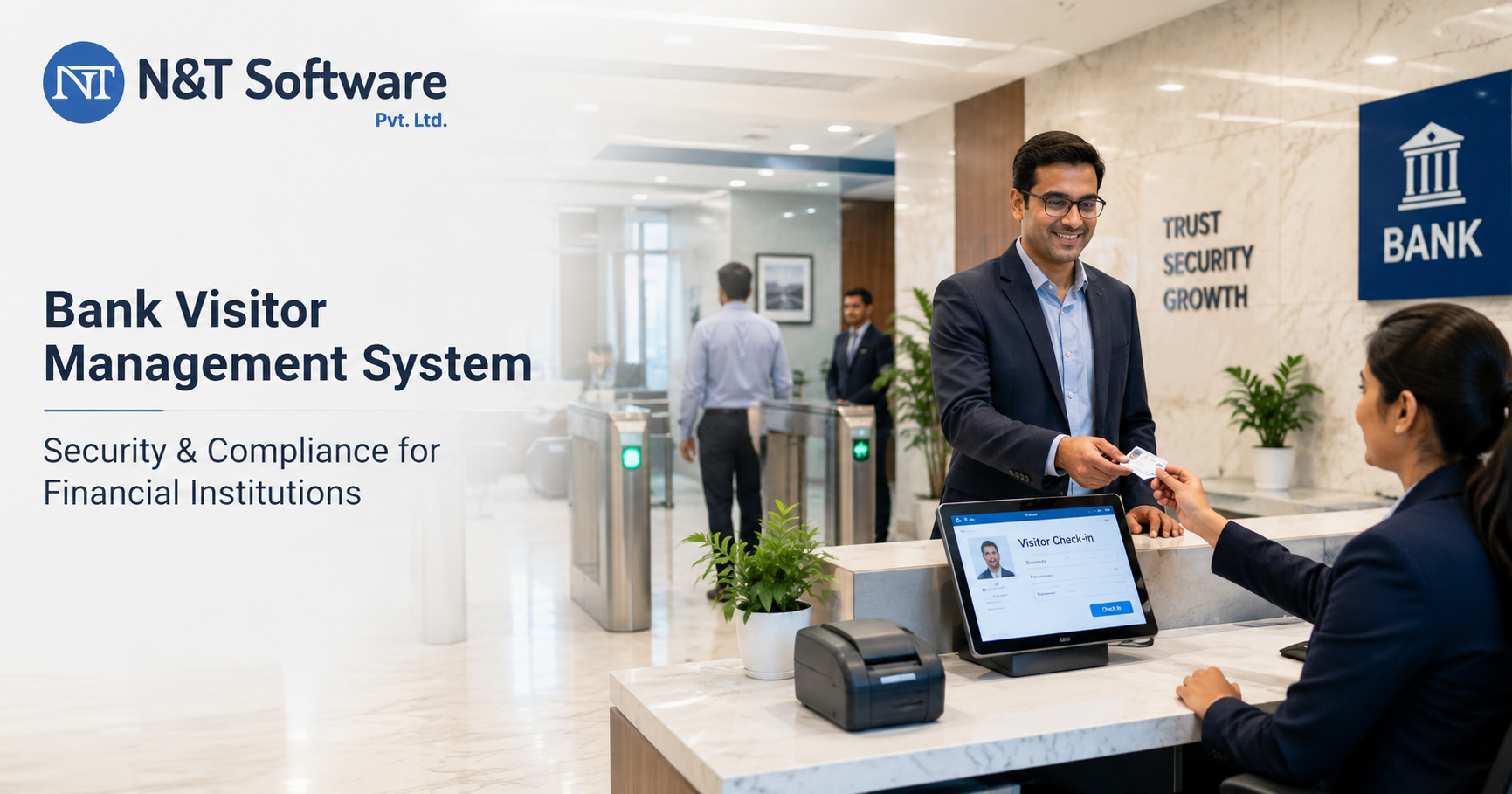
A practical 2026 guide to visitor management systems for banks and financial institutions, covering branch security, identity verification, host approvals, restricted access, audit trails, vendors, regulators, privacy, implementation and pricing.
Banks and financial institutions manage a wider range of visitors than a normal office. Customers may enter public service areas, while vendors, auditors, regulators, interview candidates, maintenance teams and business guests may need controlled access to staff-only zones. A bank visitor management system helps separate these journeys and keeps every entry, approval, pass and checkout recorded.
The objective is not simply to replace a paper register. The system should verify why a person is visiting, identify the correct host or department, apply branch or building rules, prevent unauthorized movement and provide a reliable audit trail without collecting unnecessary personal data.
Quick answer: A suitable bank visitor management system should support pre-registration, identity verification, host approval, QR or printed passes, zone-based access, vendor workflows, watchlist or exception handling, emergency occupancy, multi-branch administration and exportable audit reports.
What Is a Bank Visitor Management System?
It is visitor access and reception software configured for bank branches, head offices, regional offices, operations centres, training facilities and other financial-service locations. It records visitors, sends approvals, issues time-limited passes, tracks check-in and checkout, and restricts access according to the purpose of the visit.
The system should distinguish public customer service from controlled visitor access. A person entering a banking hall for routine service may follow a different process from a technology vendor visiting a server room, an auditor meeting compliance staff or a contractor working after business hours.
Why Banks Need a Specialized Visitor Workflow
Financial institutions operate with sensitive information, controlled rooms, cash-handling zones, critical infrastructure and strict internal procedures. A generic sign-in form may record a name but may not enforce the approvals, area restrictions and evidence required for a secure visit.
- High daily footfall in public areas with separate staff-only and restricted zones.
- Multiple visitor types, including customers, vendors, auditors, regulators, candidates and VIP guests.
- Branch-level approvals combined with central security and compliance policies.
- Need for accurate records of who entered, who approved the visit, where access was allowed and when the person left.
- Stronger controls for after-hours work, maintenance, cash-area support, data-centre access and emergency situations.
Complete Visitor Workflow for Banks and Financial Offices
1. Invitation or controlled walk-in registration
An employee can pre-register a visitor before arrival, or reception can begin a walk-in workflow. The form should request only the information needed for the visit, such as name, organization, purpose, host, expected time and any required identification details.
2. Host and department approval
The request is routed to the correct employee, department head, branch manager, security team or compliance approver. High-risk or restricted-area visits can require more than one approval before access is granted.
3. Arrival verification
Reception confirms the invitation, checks the approved identity document when required, records any permitted photo or signature, and verifies that the visit is still valid. Exceptions should be escalated instead of being bypassed manually.
4. Pass and access scope
The approved visit determines the permitted entrance, floor, department, meeting room, escort requirement and validity period. The visitor receives a time-limited QR pass, digital pass or printed badge that does not expose unnecessary personal information.
5. Checkout and access revocation
Checkout should update the live occupancy list and deactivate any connected access permission. Overdue visitors, unreturned badges and visits remaining open after closing time should appear in an exception report.
Visitor Types the System Should Support
- Business guests meeting branch, regional or head-office employees.
- Auditors, regulators, inspectors and external consultants.
- IT, ATM, CCTV, access-control, networking and equipment vendors.
- Maintenance contractors, cleaners, facility teams and delivery personnel.
- Job candidates, trainers, event participants and temporary staff.
- VIP visitors and group visits requiring coordinated reception and escort.
Essential Security Features
- Role-based access for reception, security, branch managers, hosts, auditors and central administrators.
- Host approval with backup approvers, escalation rules and multi-level approval for sensitive visits.
- QR passes, badge printing, badge return tracking and automatic pass expiry.
- Restricted-area and escort-required rules based on visitor type, purpose and branch.
- Watchlist, blocked visitor or exception checks with controlled visibility and documented handling.
- Immutable activity history for approvals, overrides, edits, badge reprints, exports and permission changes.
- Live occupancy, overdue-visitor alerts and emergency roll-call reporting.
Branch, Head Office and Operations-Centre Requirements
Bank branches
Branches need a fast reception workflow that does not delay public service. The system should clearly separate routine customer movement from visitors entering offices, meeting rooms, strong-room support zones, staff areas or operational spaces.
Head offices and regional offices
Larger offices may require multi-entrance management, parking approval, floor-based access, executive reception, visitor Wi-Fi coordination, group visits and central reporting across departments.
Operations centres and critical facilities
Technology, payment-processing, records, call-centre and data-centre locations may require stricter identity checks, dual approval, escort assignment, device declarations, restricted time windows and detailed access records.
Privacy, Retention and Compliance Controls
A visitor system can improve accountability, but it should not become an uncontrolled store of personal data. Banks should define which visitor fields are necessary, who can view them, how long records are retained, when documents or photos are deleted and how access or exports are audited.
Retention periods should reflect the institution’s legal, security and operational requirements. Sensitive visitor information should be encrypted in transit and at rest where applicable, access should follow least-privilege principles, and administrative actions should be reviewable.
Review the Visitor Data Privacy and Retention Best Practices guide when defining collection, access and deletion policies.
Integration with Security and Banking Infrastructure
A bank VMS may need to exchange approved visit information with access-control systems, turnstiles, lift controls, employee directories, CCTV workflows, parking systems, messaging services or security dashboards. Integration should use documented APIs, limited permissions and clear failure handling.
Read the Visitor Management System Integration Guide for access control, turnstiles, CCTV, directories and API planning.
Emergency and Incident Response
During an evacuation, security incident or building lockdown, authorized staff need an accurate list of visitors and contractors currently inside. The emergency view should filter by branch, floor, zone, visitor type and host, and it should support manual accountability updates without changing the original visit history.
Security teams should also be able to identify overdue visitors, cancelled passes, denied entries, manual overrides and visitors who entered but did not complete checkout.
Implementation Plan
Phase 1: Policy and process discovery
List branch types, entrances, visitor categories, restricted zones, approval owners, identification requirements, current registers, badge processes, emergency procedures and integrations.
Phase 2: Configuration and pilot
Configure roles, forms, approvals, pass templates, retention rules and notifications. Pilot the solution in one representative branch and one larger office before wider deployment.
Phase 3: Multi-branch rollout
Roll out in controlled groups, train reception and security teams, test offline or outage procedures, review exception reports and confirm that central teams can manage standards without exposing unnecessary branch-level data.
Use the Visitor Management Implementation Checklist to structure configuration, testing, training and launch.
Pricing Considerations
Pricing may depend on the number of branches, entrances, users, visitor volume, messages, badge printers, access-control integrations, implementation effort, hosting model and support requirements. Request a quotation that separates recurring software charges from setup, hardware, customization and integration costs.
Review the Visitor Management Pricing page and request an itemized proposal for your branch and security requirements.
Buyer Checklist for Financial Institutions
- Can the platform separate public customer areas from controlled visitor journeys?
- Can approvals vary by branch, visitor type, department, area and time?
- Does every override, edit, badge reprint, export and permission change appear in the audit history?
- Can passes be restricted and automatically revoked after checkout, cancellation or expiry?
- Are retention, deletion, role-based access and privacy controls configurable?
- Can central teams manage multiple branches while local teams see only their permitted locations?
- What happens during internet, printer, scanner or access-control failure?
Why Consider N&T Software
N&T Software Private Limited’s Visitor Management System can be evaluated for bank branches, head offices and other controlled financial-service environments. The demonstration should be based on your actual visitor types, approval structure, restricted areas, pass requirements and reporting needs.
A useful proof of concept should include branch reception, host approval, central administration, QR or badge check-in, vendor handling, role-based access, multi-location reporting and the required security integrations. Final scope should be confirmed after reviewing the bank’s policies, infrastructure and compliance requirements.
Frequently Asked Questions
Can a visitor management system be used in bank branches?
Yes. It can manage business visitors, vendors, auditors, contractors and other approved guests while keeping routine customer service separate from staff-only access.
Can the system support multiple bank branches?
Yes. A multi-location platform can apply central standards while allowing branch-specific approvers, working hours, visitor categories, entrances and reports.
Can it connect with access-control systems?
It can when compatible APIs or integration methods are available. The approved visit can be used to create time-limited access that is revoked after checkout, cancellation or expiry.
How should visitor identity documents be handled?
Collect or store only what the institution’s policy and applicable requirements justify. Limit access, define retention, protect stored data and document when copies or images are deleted.
How much does a bank visitor management system cost?
Cost depends on branches, users, visitor volume, integrations, hardware, implementation and support. Compare itemized proposals based on the exact security workflow rather than only the headline subscription.
Related Resources
- Data Center Visitor Management System — Secure access and compliance guidance for critical facilities.
- Visitor Management System Integration Guide — Plan access control, CCTV, directory and API integrations.
- Visitor Data Privacy and Retention — Define appropriate collection, access, retention and deletion controls.
- Visitor Management Implementation Checklist — Organize configuration, pilot testing, training and rollout.
Final Recommendation
A bank visitor management system should make authorized visits easier to process while making unauthorized movement harder. The strongest solution combines clear approvals, controlled passes, branch-level flexibility, central governance, privacy controls and reliable evidence of every important action.
Before selection, test the platform using realistic scenarios: a normal business guest, an auditor, an after-hours vendor, a restricted-area visit, a denied approval, an overdue visitor, an evacuation and a failed integration. The results will show whether the workflow is practical for both security teams and branch operations.
Contact N&T Software to discuss a visitor management demonstration for your bank, financial institution or multi-branch office network.