A practical 2026 guide to calculating visitor management system ROI, manual reception costs, annual savings, payback period, budget approval and post-launch KPIs.
A visitor management system is often evaluated only as a reception or security expense. A stronger business case measures how the system can reduce repetitive front-desk work, shorten visitor check-in time, automate host notifications, simplify authorised reporting and improve multi-location administration.
This guide explains how to calculate visitor management system ROI, estimate a realistic payback period and present the result to finance, facilities, security and IT teams. The method is globally applicable, but every organisation should replace the example figures with verified local labour, hardware, hosting and support costs.
Quick answer: visitor management ROI formula
ROI percentage equals net annual benefit divided by total first-year investment, multiplied by 100. Net annual benefit is the verified annual value created by faster processing, reduced administration and other measurable improvements, minus software, setup, hardware, integration, training and support costs.
Six calculations for a defensible ROI model
- Annual manual-processing cost = daily visitors × minutes per visitor ÷ 60 × hourly staff cost × annual working days × locations.
- Annual time-saving value = annual manual-processing cost × the percentage of repetitive work removed and verified through a pilot.
- Total annual benefit = time-saving value + verified reporting savings + reduced consumables + avoided duplicate work.
- Net annual benefit = total annual benefit − annual software, hosting, support, hardware and integration costs.
- ROI percentage = net annual benefit ÷ total first-year investment × 100.
- Payback period in months = initial implementation investment ÷ average monthly net benefit.
Illustrative visitor management ROI example
Consider a three-location organisation receiving 50 visitors per day at each location. Assume the current manual process takes four minutes per visitor, the relevant staff cost is USD 18 per hour and the facilities operate for 250 working days per year.
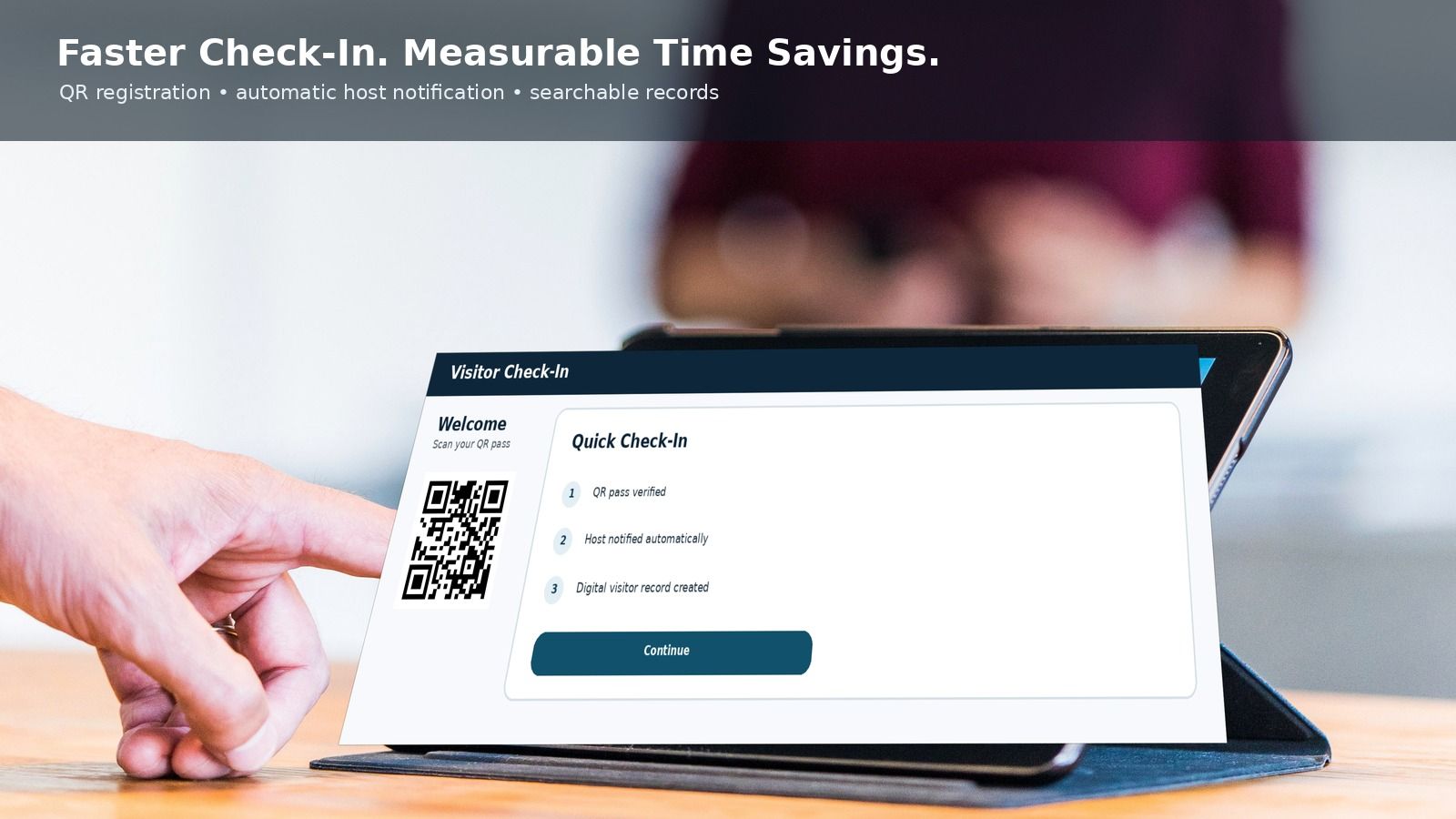
The estimated annual manual-processing cost is USD 45,000. If a controlled pilot confirms that pre-registration, QR check-in and automatic host notifications remove 60% of repetitive handling, the estimated annual time-saving value is USD 27,000.
If the complete first-year cost is USD 8,000, the simplified net annual benefit is USD 19,000. The illustrative ROI is 237.5%, with an approximate payback period of five months. This is an example only and is not a promised result.
Include the complete cost, not only the subscription
Use the Visitor Management System Cost and Pricing Guide 2026 to review software fees, branch charges, implementation, hardware, integration, hosting, training, warranty, maintenance and support.
- Software subscription, licence or per-location charges
- Workflow configuration, setup, migration and training
- Kiosks, tablets, badge printers, scanners, cards and consumables
- Access-control, HRMS, CCTV, directory or API integration
- Hosting, technical support, maintenance and future upgrades
Where measurable visitor management savings come from
Faster registration and check-in
Pre-registration, repeat-visitor records, QR passes and self-service kiosks can reduce repetitive typing. Measure the current and pilot check-in times instead of assuming a standard saving.
Fewer host-notification interruptions
Automatic email, WhatsApp or configured notifications can reduce manual calls and repeated searches for the correct employee or department.
Lower reporting and correction effort
Searchable visitor records can reduce time spent combining branch registers, correcting illegible entries, finding missing checkouts and preparing authorised reports.
More efficient multi-location administration
Central policies, branch-level permissions and consolidated reporting can remove repeated administration across facilities that currently use separate paper or spreadsheet processes.
Benefits that should not be exaggerated
A credible business case separates measurable savings from strategic benefits. Security, privacy, visitor experience and emergency visibility are important, but they should not be converted into invented financial values.
- Do not claim that software prevents every unauthorised entry or incident.
- Do not treat all recovered reception time as direct payroll savings.
- Do not exclude training, hardware replacement or integration support.
How to build the business case
- Document visitor volume, handling time, notification steps, reporting work, exceptions and branch differences.
- Measure a baseline during a normal operating period.
- Use the Visitor Management System RFP Template to separate mandatory requirements from optional features.
- Compare suitable providers through the Best Visitor Management Software Providers 2026 guide and request a verified quotation.
- Run a representative pilot using the Visitor Management System Implementation Checklist and replace estimates with measured results.
- Present conservative, expected and high-value scenarios rather than one overconfident forecast.
KPIs to measure after launch
- Average visitor check-in time
- Percentage of expected visitors pre-registered
- Host-notification and approval response time
- Reception or guard handling minutes per visitor
- Manual corrections and missing checkouts per 1,000 visits
- Time required to produce an authorised visitor report
Using the ROI model worldwide
The calculation method is global, but the inputs are local. Use the relevant labour rate, currency, working days, taxes, hosting requirements, hardware availability and support model for each country. The Visitor Management Software by Industry and Country Resource Hub connects this business case to industry and location-specific guidance.
How ROI priorities change by facility type
Corporate offices and commercial buildings
The strongest measurable benefits often come from pre-registration, self-service check-in, host notifications and shared reception. Review the office and workplace visitor management guide for relevant workflows.
Factories, warehouses and contractor-heavy sites
The business case may include faster contractor onboarding, document checks, gate workflows and time-on-site reporting. Use the industrial visitor management software comparison to define measurable operational requirements.
N&T Software ROI planning
N&T Software provides configurable visitor registration, QR or OTP workflows, host notifications, badges and gate passes, role-based access, multi-location reporting and integration options. Published N&T guidance has referenced selected configurations from about USD 1.19 per day per branch. Final pricing depends on locations, workflow, hosting, hardware, integration and support requirements.
Review the Visitor Management Software platform, check current pricing information or request a tailored quotation using actual visitor volumes and site requirements.
Frequently asked questions
What is a good ROI for a visitor management system?
There is no universal percentage. A good result uses verified baseline data, complete ownership costs and measurable operational improvements.
How quickly should the system pay for itself?
Payback depends on visitor volume, manual processing time, number of locations, implementation cost and adoption. High-volume multi-site operations may recover measurable value faster.
Can security benefits be included?
They can be described as strategic or risk-reduction benefits. Assigning a financial amount requires a documented method approved by the organisation.
Should reception salaries be included?
Use only the proportion of staff time spent on visitor-related work. Recovered time may improve service capacity without directly reducing payroll.
Final recommendation
Measure the current process first, include every relevant cost, validate assumptions through a pilot and track the same KPIs after launch. A credible ROI model improves budget decisions without relying on exaggerated security or compliance claims.