Visitor management software is no longer just a digital sign-in tool. This guide explains how different industries use enterprise visitor management systems to improve security, compliance, safety, visitor experience, and operational efficiency.
Introduction
Visitor management used to mean a paper logbook, a receptionist, and a badge sticker. That model breaks down quickly once an organization has multiple sites, regulated spaces, contractor traffic, or audit requirements. Modern platforms replace manual sign-in with pre-registration, ID capture, badge printing, host notifications, real-time occupancy, and exportable audit trails. Enterprise platforms also standardize those controls across locations, which is why they are increasingly positioned as part of the security and workplace stack, not just a front-desk convenience tool.
An enterprise visitor management system matters most when visitor flow intersects with physical security, privacy, contractor risk, or emergency accountability. That is why the use cases vary sharply by industry. A school cares about safeguarding students and controlling access to student-linked information. A hospital cares about patient privacy, visitor policies, and facility-access safeguards. A manufacturing site cares about contractors, permits-to-work, timed access, and safety acknowledgments. A data center cares about approvals, identity checks, and audit-ready logs tied to regulated or customer-audited environments.
Industry-by-industry use cases
Education
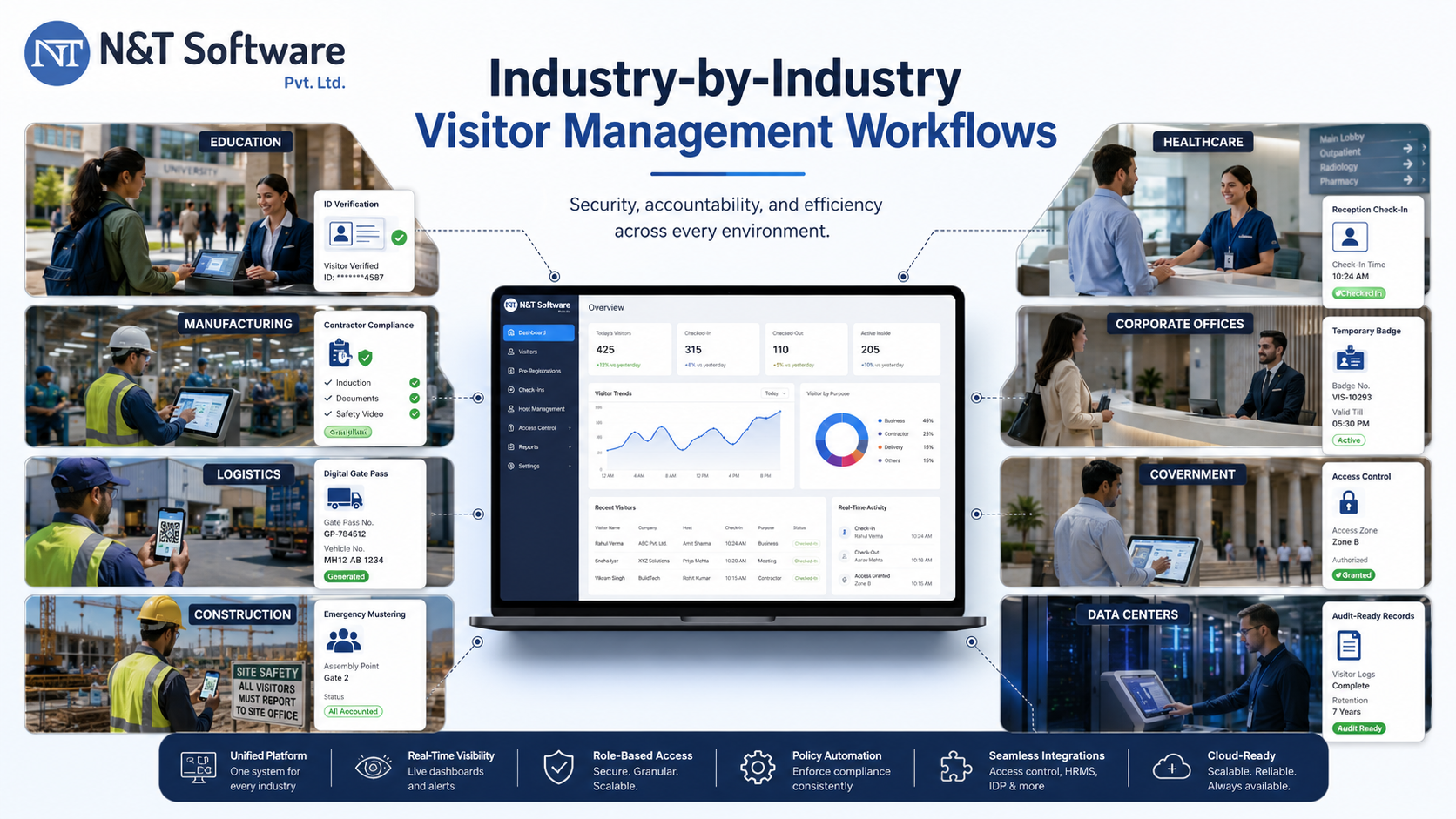
In education, visitor management software is primarily a safeguarding and front-entrance control tool. Common workflows include parent and volunteer sign-in, ID scanning and verification, badge printing, school-specific watchlist checks, and host notifications. Because schools may handle student-linked information, procurement teams also need to think about how vendor contracts, disclosures, and data use align with FERPA’s rules around education records and outsourced school functions. In other words, the system must support both safety and privacy governance.
Healthcare
In healthcare, the strongest use cases are patient visitor control, vendor management, auditability, and privacy-by-design workflows. HHS guidance under the HIPAA Security Rule requires policies and procedures to limit physical access to systems and facilities housing ePHI while allowing properly authorized access; it also requires audit controls. That makes digital visitor screening, restricted-area workflows, electronic acknowledgments, and searchable visitor records operationally useful, even though software alone does not “make” an organization HIPAA compliant. Healthcare vendors also emphasize visitor routing, patient-location-aware workflows, and infection-control-aware visitation processes.
Manufacturing
In manufacturing, visitor management frequently becomes a contractor compliance and plant safety system. OSHA’s process-safety interpretation states that employers must develop procedures to control the entrance, presence, and exit of contract employers and contract employees in covered process areas. That is why manufacturing deployments commonly include contractor-specific check-in, safety attestations, permits-to-work, timed badges, host approval, and end-of-shift badge expiry. The ROI can be significant when orientations or induction paperwork are embedded into check-in rather than handled manually.
Corporate offices
For corporate offices, the dominant use case is a branded, efficient, multi-site digital front door. The workflow usually includes pre-registration from calendars, fast arrival check-in, photo or ID verification, badge printing, access-control-triggered door or turnstile permissions, and centralized oversight across locations. This is the clearest dividing line between a basic sign-in app and an enterprise platform: enterprises want one dashboard, one policy model, and one audit trail across all sites, plus integrations that reduce manual work for IT, facilities, HR, and reception teams.
Retail
Retail use cases are often underappreciated because the real need is usually back-of-house and supplier control, not customer admission. Store support vendors, merchandisers, auditors, facilities contractors, and regional teams require a digital record of who entered, why, and for how long. At headquarters and distribution centers, organizations also use VMS workflows for confidentiality acknowledgments, supplier code-of-conduct signoff, and fast branded badging. In higher-risk environments, these workflows can support broader loss-prevention programs by linking visitor identity, access rules, and surveillance-aware procedures.
Logistics and warehousing
In logistics and warehousing, the key use case is gatehouse and yard flow management. Vendor and driver traffic is high, repetitive, and operationally sensitive. Warehouse-focused workflows often pre-screen drivers, verify a load or purchase order, print a yard pass, share dock instructions, alert dispatch, and track dwell times. Contractor and maintenance workflows add permits-to-work, safety confirmations, and timed access to service areas. Here, visitor management software overlaps directly with throughput, security, and detention-cost control.
Government
Government sites use visitor management to balance public accessibility with access restriction, identity verification, and auditability. NIST guidance is explicit that physical access control applies to employees and visitors and that physical access points can use procedural logs, automated logs, or both. Government-focused VMS implementations therefore emphasize ID verification, designated-area access, watchlist-aware processes, accurate records for investigations, and alignment with broader FISMA/NIST risk management expectations. These environments are also more likely to require strict segregation of visitor types and approval paths.
Events and hospitality
For events and hospitality, the strongest use case is high-volume, low-friction guest processing. Hotels and event venues need bulk pre-registration, QR-based arrival, instant host or front-desk notification, and separate workflows for guests, contractors, and vendors. Vendor-oriented hospitality workflows often include NDA capture or contractor acknowledgments before badges print. For conferences, weddings, and corporate events, the value comes from moving large groups through entry quickly while still preserving a verified attendance record.
Construction
Construction sites use visitor management for site accountability, workforce/visitor separation, and safety documentation. Portable check-in and check-out stations, badge-gated turnstiles, and zone control are common because the worksite changes constantly. OSHA’s confined-space and contractor coordination requirements reinforce the need for disciplined entry control where host employers and contractor personnel may work near hazards. In practice, that means visitor workflows often include safety rules, site induction, access-by-zone, and accurate “who is on site” reporting for emergency response.
Data centers
Data centers use visitor management software as a compliance-supporting security control. Common workflows include pre-approval, identity verification, contractor document checks, badge issuance, escort rules, and detailed, exportable visit logs. Vendors in this segment explicitly position VMS as support for audit-heavy environments where SOC 2, ISO 27001, customer security reviews, and incident-response readiness matter. For procurement teams, the important point is that visitor records must be exportable, access must be time-bound, and integration with access control and identity systems must be robust.
Integrations, KPIs, ROI, and migration guidance
The most valuable integrations are the ones that remove duplicate work and policy gaps. Access control integration can automatically provision or expire temporary access and tie badge state to visit state. SSO and directory integrations make administration safer and simpler by syncing users through Microsoft Entra, Okta, OneLogin, or SAML-based authentication. APIs extend this into facility systems, while some vendors explicitly support CCTV-linked workflows and broader visitor identity management models with HR and IAM sources such as SAP, Workday, and Okta. In manufacturing and logistics, ERP-linked gate-pass workflows can connect check-in to material movement or inbound-delivery processes.
The KPIs that matter most are usually operational, not just security-centric. Track median check-in time, pre-registration rate, visitor-to-badge issuance time, percentage of visitors completing required documents before arrival, host response time, same-day audit retrieval time, contractor safety-induction completion, occupancy accuracy during drills, and percentage of visits automatically tied to access rules. Enterprise tools increasingly expose these analytics globally across locations, which is useful for benchmarking and procurement renewal decisions.
ROI usually appears in a mix of labor savings, less paper handling, faster audits, fewer gate bottlenecks, and better contractor throughput. One published example is Valmet, where integrating safety orientations into check-in reduced contractor training time by more than 90%, from up to an hour to five minutes. Another case study from Maple Lodge Farms highlighted faster reporting, better visibility across multiple locations, and savings on paper, toner, and storage space. These are the kinds of outcomes procurement teams should model in a business case.
Migration from paper to digital works best when done in phases. Start with one site or one visitor type, clean up host directories and approval rules, define retention and privacy notices, map visitor types to badge/access rules, then roll out integrations. Staff training matters in every sector, especially where check-in speed and policy consistency are critical. It is also important not to assume that “digital” means “secure”: visitor kiosks and reception devices should be hardened, patched, role-restricted, and managed with the same discipline as other security-adjacent endpoints.

FAQ
What are visitor management software use cases?
Visitor management software use cases are the practical ways organizations apply digital visitor workflows to real operations, such as school safeguarding, hospital visitor policies, contractor control in manufacturing, corporate guest check-in, warehouse driver processing, and audit-ready access in government or data-center environments.
What makes an enterprise visitor management system different from a basic sign-in app?
An enterprise visitor management system supports multi-site standardization, centralized reporting, role-based workflows, integrations with access control and SSO, and deeper auditability. Basic sign-in apps normally focus on a single lobby workflow without that broader governance layer.
Which industries benefit the most from visitor management software?
The highest-value environments are those with heavy contractor traffic, privacy obligations, high visitor volume, or security-sensitive spaces. That includes education, healthcare, manufacturing, logistics, government, construction, and data centers, plus multi-site corporate offices.
Does visitor management software help with compliance?
Yes, but indirectly. A VMS supports compliance by enforcing policy, limiting access, capturing acknowledgments, and producing audit-ready records. It can support HIPAA-, FERPA-, OSHA-, or NIST-aligned processes, but it does not replace legal, security, or policy controls by itself.
What integrations matter most?
The highest-impact integrations are usually access control, SSO/directory sync, APIs, analytics, and—depending on the site—CCTV, ERP/gate pass systems, and broader identity management platforms. These reduce duplicate entry, tighten access rules, and improve audit quality.
How do manufacturing sites use visitor management software?
Manufacturing teams typically use it for contractor sign-in, safety acknowledgments, permits-to-work, timed site access, and auditable records of who entered, where they were authorized to go, and when they exited.
How do hospitals use visitor management systems?
Hospitals use them to manage patient visitors, vendors, contractors, and restricted-area access while preserving privacy, auditability, and authorized-access controls around systems and facilities that handle ePHI.
What are the best KPIs to track after rollout?
The most useful KPIs are median check-in time, pre-registration rate, badge issuance time, host response time, percentage of visits with complete documents, audit retrieval time, occupancy accuracy, and contractor safety-completion rates. Enterprise platforms increasingly expose these metrics centrally across sites.
How should organizations migrate from paper to digital?
Start with a pilot, clean up host directories and approval policies, define retention and privacy rules, train staff, test integrations, and then expand site by site. Strong change management matters as much as the software itself.
Are digital visitor kiosks always secure?
No. Digital systems are generally more controllable and auditable than paper, but kiosk devices still need hardening, patching, role restrictions, and secure authentication. Security researchers have previously documented kiosk vulnerabilities in mainstream visitor-management products, which is why endpoint governance matters.