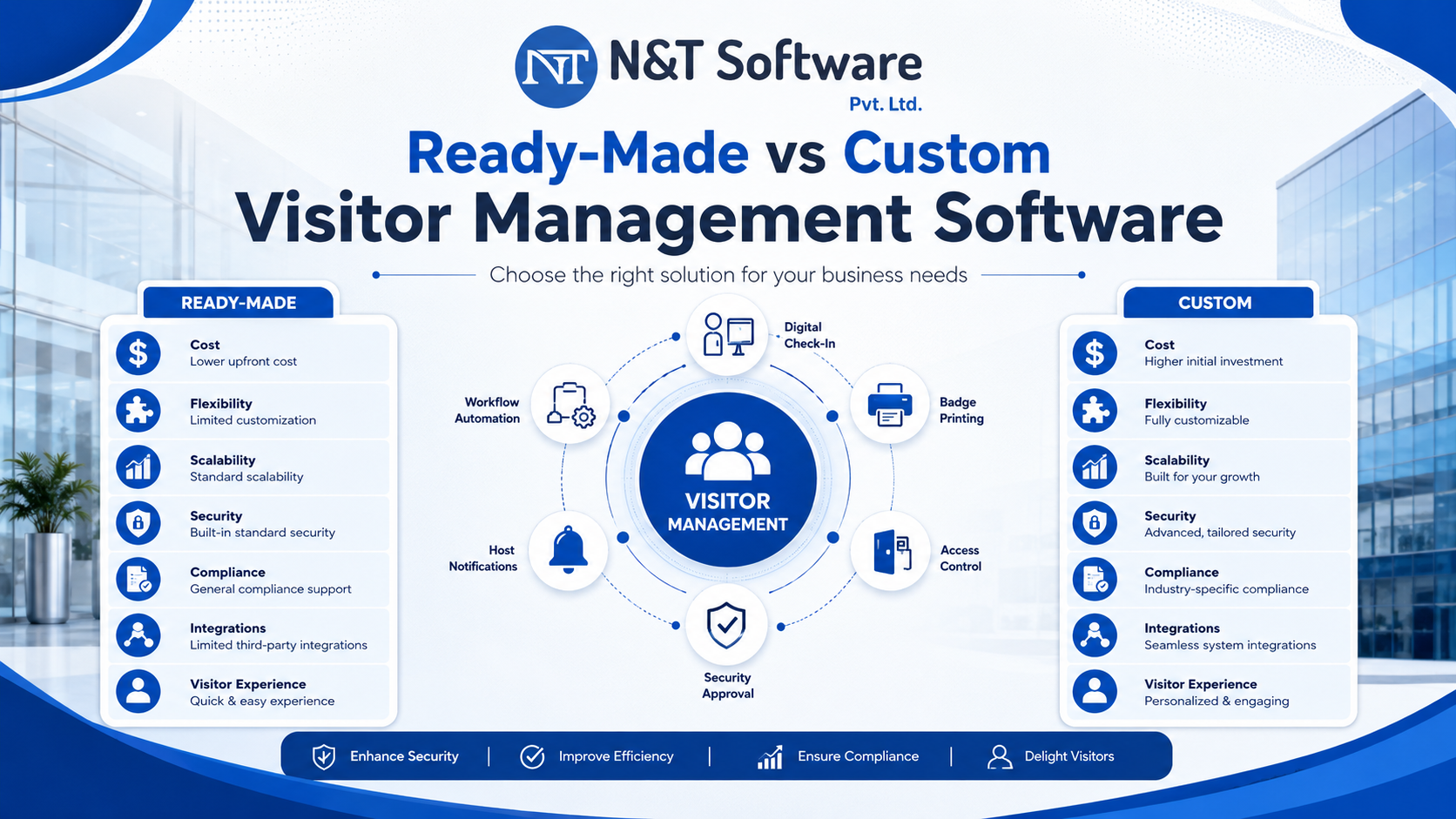
Choosing between custom visitor management software and a ready-made visitor management solution depends on your business workflows, security needs, integrations, budget, and long-term scalability. This guide compares both options to help organizations make the right decision.
Custom Visitor Management Software vs Ready-Made Solutions

Why visitor management software has become a strategic business system
Visitor management software is no longer just a digital replacement for a paper sign-in book. In security-sensitive and compliance-driven environments, it has become part of the organization’s broader physical access, audit, and risk posture. NIST’s guidance is a useful benchmark here: SP 800-53 says visitor access records should capture details such as the visitor’s name and organization, identification used, entry and departure times, purpose of visit, and the person visited, while also emphasizing automated record maintenance and review where appropriate. NIST SP 800-171 likewise requires organizations to escort visitors and control visitor activity as part of physical access control.
That shift is visible in real-world practice. ASIS Foundation’s 2023–24 access control research found that 39 percent of organizations still tracked temporary visitor credentials manually, 15 percent did not issue temporary credentials at all, and only 40 percent used only digital systems such as PIAM or access control technology across all sites. The same research found that 42 percent had integrated access control with visitor management, and that organizations using digital methods to track temporary credentials reported materially higher confidence in the effectiveness of their overall access control systems than organizations relying on manual methods. In other words, visitor management is increasingly tied to measurable security maturity, not just lobby convenience.
That is the backdrop for the core buying decision: should you invest in custom visitor management software, or choose a ready-made platform and configure it to fit your operation? The answer depends less on ideology and more on whether your requirements are truly unique enough to justify the long-term cost and ownership of visitor management software development.
What custom visitor management software really offers
At its best, custom visitor management software gives an organization exact control over workflows, data handling, user roles, integrations, and on-site experience. If your business needs nonstandard approval chains, site-specific badge logic, multiple legal disclosures by visitor type, complex contractor lifecycles, or deep connections to proprietary access-control systems, a custom build can model those requirements directly instead of forcing staff to work around a generic product. That matters because the underlying controls themselves can be highly specific: NIST emphasizes detailed visitor records, periodic review, and limiting personally identifiable information to what is operationally necessary. A custom build can enforce those rules exactly as your security or legal team defines them.
Custom development also gives you more freedom in architecture. You can choose the data model, hosting pattern, retention logic, approval engine, and reporting design that match your internal governance. That can be especially attractive for organizations with unusual privacy obligations, site-by-site policy variation, or legacy infrastructure that modern SaaS products do not support cleanly. NIST’s Secure Software Development Framework is relevant here because it explicitly frames secure software development as a set of practices that must be integrated into each SDLC implementation rather than assumed automatically. In other words, custom software can absolutely be secure and scalable, but only if you deliberately build it that way.
The trade-off is ownership. A custom system does not end when version one launches; it becomes an internal product. Security patches, browser and OS changes, badge printer issues, mobile device changes, API breakage, and evolving compliance requirements all become your problem or your vendor’s under a retained development contract. The IEEE Computer Society notes that maintenance begins after deployment and commonly occupies over half of total lifecycle costs, which is why the economics of custom systems are often underestimated during procurement. That is the hidden line item in many visitor management software development projects: not the build, but the years of upkeep.
Where ready-made visitor management software wins
Ready-made platforms usually win on speed, predictable pricing, and feature maturity. Envoy says its visitor management system can be set up in minutes, offers a free basic tier, lists Standard at $109 per location per month billed annually, and reserves advanced security and access-control integrations for custom-priced Enterprise plans. The Receptionist publishes annual per-site pricing starting at $630 for Core, $1,260 for Enhanced, and $1,890 for Pro. Sign In App says most multi-site organizations can be up and running in days rather than months. For buyers who need results this quarter—not after a multi-sprint product roadmap—that matters.
Modern off-the-shelf products are also more configurable than many teams assume. Envoy supports customizable sign-in flows, host notifications, SSO and directory integrations, identity verification, legal document capture, access-control integrations, and more than 100 integrations, with an open API for additional workflows. Eptura supports data retention policies, automated deletion by location, role-based viewing rights, SSO, access-control integrations, calendar and chat integrations, guest Wi-Fi, and secure cloud hosting on Microsoft Azure. Sign In App supports kiosk, QR code, and contactless check-in, pre-registration, digital policy acknowledgments, integrations and API access, and detailed audit trails for compliance reporting. For many organizations, that functionality is enough to avoid a bespoke build entirely.
Security is another area where ready-made platforms can be stronger than a lightly resourced custom build. Envoy documents TLS 1.2+ for data in transit, AES-256 disk encryption at rest, daily backups, and configurable retention options. Eptura states that visitor data can be securely stored and processed under applicable privacy laws, offers custom retention and deletion controls, and says Eptura is ISO 27001 certified and GDPR compliant. Sign In App states that visitor and employee information is encrypted, access-controlled, and supported with retention and privacy settings aligned to GDPR, CCPA, and SOC 2 needs. A custom build can reach that level, but only if you budget for the same rigor.
The main limitation of ready-made software is fit. Even flexible platforms have opinionated data models, predefined admin experiences, and supported integration lists. Eptura highlights broad—but still listed—support across access-control, calendar, chat, SSO, printers, and guest Wi-Fi. Envoy likewise offers a large marketplace and a “build your own” path, which is useful but also hints at the practical boundary of out-of-the-box functionality. If you run heavily customized physical security infrastructure or need truly unusual workflows, you may still face compromise, middleware work, or partial process redesign. That is an inference from how these platforms are structured, not a flaw unique to any one vendor.

Comparing cost, flexibility, scalability, security, and user experience
On cost, ready-made platforms usually have the lower barrier to entry. You get subscription pricing, faster implementation, and a vendor that spreads product maintenance across many customers. Custom visitor management software front-loads discovery, design, engineering, testing, rollout, and post-launch support, then continues to incur maintenance cost over time. That does not make custom “more expensive” in every case—especially if it replaces fragmented tools and manual labor at scale—but it does mean the total cost of ownership has to be modeled across years, not just initial delivery.
On flexibility, custom is the ceiling. If you truly need a visitor workflow that maps directly to your facilities, legal obligations, or internal systems, nothing beats building exactly what you need. But there is a practical nuance here: the baseline flexibility of ready-made tools is now much higher than it was a few years ago. Envoy offers configurable sign-in flows and open APIs; Eptura offers customizable retention, deletion, roles, and major workplace/security integrations; Sign In App supports customization, mobile and kiosk sign-in, APIs, and digital document handling. Custom should therefore be reserved for requirements that are genuinely differentiating, not just requirements that were never tested against modern platforms.
On scalability, ready-made tools often have the advantage because they are already designed for multi-site deployment, repeatable administration, and continuous updates. Sign In App says most organizations can replicate configurations and deploy to new locations with a few clicks. Envoy says new locations can be launched in minutes by copying existing settings. Eptura positions its platform for one location or dozens, including access-control integrations across different environments. A custom platform can certainly scale, but that scalability has to be engineered, tested, and funded rather than assumed.
On security and compliance, the gap is not “custom versus SaaS” so much as “well-governed versus under-governed.” NIST’s SSDF and CISA’s Secure by Design guidance both make the same point in different ways: security has to be built into the development lifecycle and owned by the manufacturer or builder. Ready-made platforms may already have encryption, audit trails, retention controls, and compliance documentation; custom software can do the same, but only with disciplined engineering and ongoing oversight. For high-risk buyers, this often becomes the deciding criterion.
On user experience, ready-made tools start from a strong position because they have already refined self-service flows such as pre-registration, host notifications, QR check-in, badge printing, and digital NDA capture. Envoy and Sign In App both emphasize streamlined, low-friction arrival experiences, while Eptura focuses on an intuitive and memorable lobby experience. Custom wins only when your visitor journey needs to be unusually branded, deeply contextual, or operationally distinct. Otherwise, there is a real risk that a custom build delivers less polish than a mature commercial product.
When visitor management software development is the right move
The best buying rule is simple: build only when the process itself is a competitive, compliance, or operational differentiator.
- Choose custom visitor management software when you have non-negotiable workflow complexity, proprietary or unsupported integrations, strict internal governance that cannot be modeled in commercial tools, or a strategic reason to own the product roadmap and data architecture yourself. In those cases, visitor management software development can create a better fit and stronger long-term control—provided you also fund security, testing, and maintenance properly.
- Choose a ready-made visitor management platform when your core needs are common: secure check-in, pre-registration, badge printing, host notifications, audit trails, identity verification, and integration with mainstream workplace or access-control tools. The faster deployment, transparent pricing, and mature feature set will usually produce better time to value.
- Consider a hybrid model when your needs are mostly standard but you still require some differentiation. In practice, that means buying the core platform and extending it with APIs, automation, or limited custom modules rather than commissioning a full bespoke system from scratch. Envoy’s open API and integration marketplace, along with Sign In App’s integrations and API capabilities, make that path realistic for many organizations.
The bottom line for buyers
Custom visitor management software is not automatically the premium choice, and ready-made software is not automatically the compromise. The strongest option is the one that matches your actual risk profile, integration landscape, regulatory obligations, rollout timeline, and internal capacity to own software over time. The evidence suggests that organizations benefit from moving beyond manual visitor processes, integrating visitor management with the wider access-control stack, and choosing systems that produce auditable records, controlled visitor activity, and strong data protection.
If your requirements are highly specific, visitor management software development may be worth the investment. If your needs are mainstream and speed matters, a ready-made platform will usually deliver better ROI sooner. Before you choose, map your must-have controls, integrations, retention rules, and user journeys in detail—then decide whether you truly need a custom product, or simply a well-configured one. Need a visitor management solution built around your business process? Consult N&T Software for custom visitor management software development tailored to your security, workflow, and integration needs.