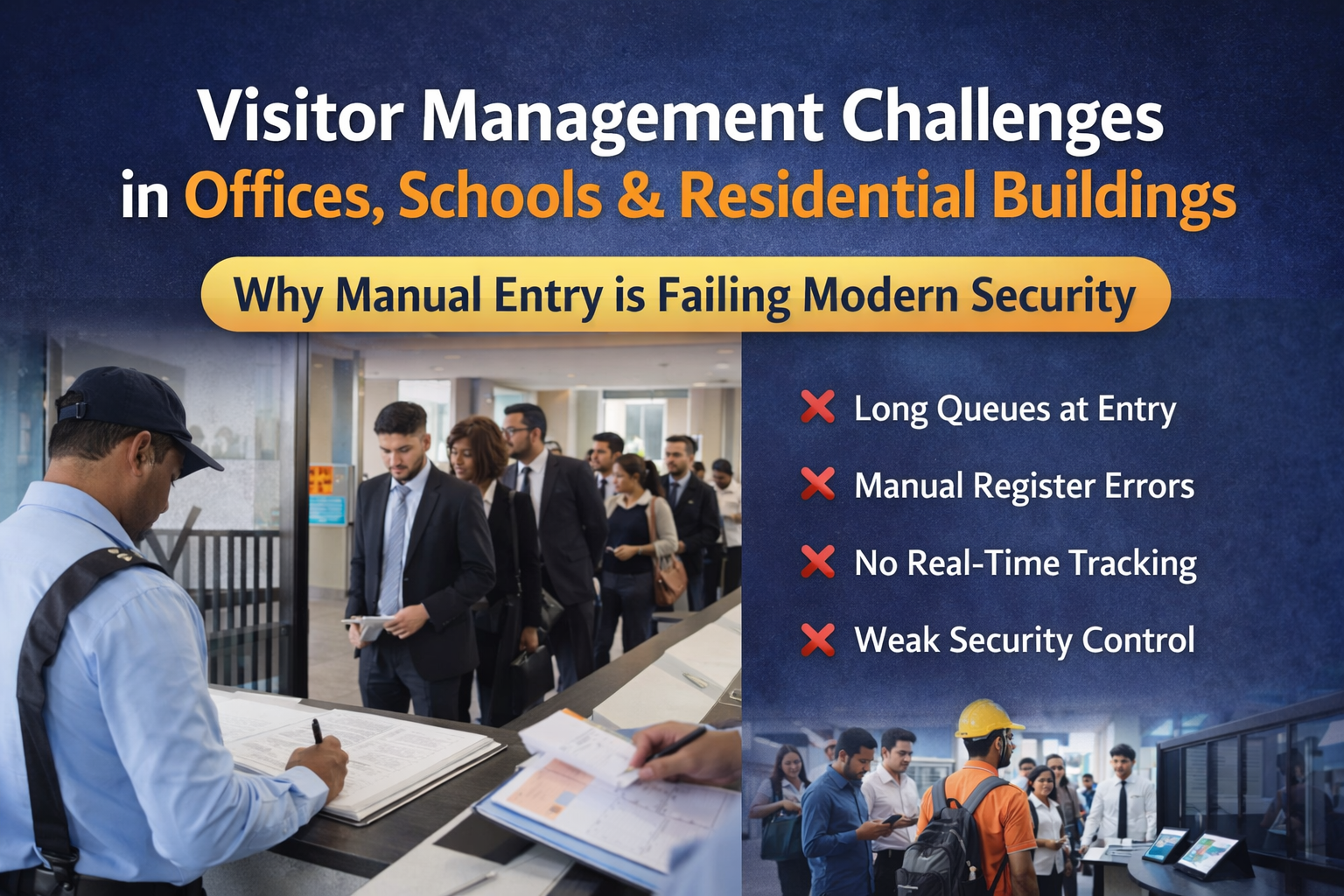
Visitor management sounds simple until long queues, missing records, unauthorized access, and manual errors begin affecting daily operations. This blog explores the most common visitor management challenges in offices, schools, and residential buildings, and explains what modern organizations should do to solve them.
Common Visitor Management Challenges in Offices, Schools, and Residential Buildings
Visitor entry is one of those daily processes that many organizations underestimate until it starts creating real problems.
At first, it looks manageable. A guard writes names in a register. A receptionist makes a quick phone call. A resident approves a guest over the phone. A school gatekeeper checks a visitor manually. It feels routine, familiar, and “good enough.”
But that confidence usually lasts only until traffic increases, a security incident occurs, records go missing, or management realizes there is no clean way to verify who entered, why they came, who approved them, and when they left.
This is where visitor management challenges become more than an administrative inconvenience. They begin to affect security, compliance, speed, accountability, and the overall experience people have with the premises.
In offices, poor visitor handling can create an unprofessional first impression and leave security teams blind to who is inside the building. In schools, it can raise serious concerns around student safety and gate control. In residential buildings and gated communities, weak guest tracking can frustrate residents, overload gate staff, and increase exposure to unwanted entry.
The truth is simple: visitor movement is not just a front-desk activity anymore. It is a live operational layer connected to safety, control, and trust.
This is exactly why more organizations are taking a closer look at the manual visitor entry problems and broader security management issues hidden inside their current process.
Why Visitor Management Is No Longer a Small Issue
The traditional idea of visitor management was built for a different era.
It assumed fewer visitors, slower movement, lower compliance pressure, and simpler security expectations. A notebook at the gate or a basic spreadsheet in the reception area once seemed acceptable because the volume was smaller and the risk was easier to ignore.
That is no longer the case.
Today, buildings handle a mix of guests, interview candidates, vendors, service technicians, delivery personnel, parents, contractors, maintenance teams, short-term visitors, and recurring external staff. The variety alone makes manual control difficult. The pace makes it worse.
Every entry point now has to answer important questions quickly:
- Who is this person?
- Why are they here?
- Who approved them?
- What area can they access?
- Have they completed the required checks?
- Are they still inside?
- When did they leave?
If these questions cannot be answered confidently and in real time, the process is weak.
And when the process is weak, the effects begin to show everywhere: long queues, poor coordination, unauthorized movement, missing records, frustrated hosts, and inconsistent gate decisions.
1. Manual Entry Creates Delays at the Gate
One of the biggest manual visitor entry problems is speed.
Manual processes are slow by design. Someone has to ask the visitor for details, write them down, verify the purpose of the visit, contact the host, issue a pass, and then repeat the process for the next person. During busy hours, this creates congestion almost immediately.
In an office, this may mean clients and candidates waiting at the reception desk. In a school, it may mean parents and vendors crowding the gate during start or dismissal hours. In a residential building, it often means guest vehicles piling up while guards try to confirm flat numbers and approvals.
The operational damage is bigger than it looks. Delays at entry points affect staffing efficiency, reduce control, and create pressure to “just let people in quickly,” which is exactly when mistakes happen.
Long queues are not only a convenience issue. They are a security issue.
2. Poor Handwriting, Incomplete Details, and Human Error
Manual systems depend heavily on people getting everything right every time.
That almost never happens consistently.
Names are misspelled. Mobile numbers are entered incorrectly. Visit purposes are vague. Entry times are missed. Exit times are forgotten. A guard may skip details during rush periods. A receptionist may not record the host name properly. A resident may verbally approve a guest without any reliable digital trail.
When records become incomplete, they lose value. A register full of half-written entries is not a dependable visitor history. It is just paper filled under pressure.
This becomes a major problem when management needs to review a past incident, verify a complaint, investigate a loss, or respond to a safety issue. If the data is unclear, the organization is left with assumptions instead of evidence.
3. No Real-Time Visibility of Who Is Inside
A surprisingly common issue in offices, schools, and residential buildings is that management often does not have a live, trustworthy list of who is currently inside the premises.
That creates a dangerous blind spot.
Without real-time visitor visibility, it becomes difficult to answer basic operational questions:
- How many visitors are currently inside?
- Which vendor entered the building this morning?
- Has the contractor left?
- Which parent is on campus right now?
- Did the delivery person exit the premises?
- How many guests are active in Tower B?
This is one of the most serious security management issues in outdated visitor systems. If there is an emergency, an evacuation, a theft complaint, or a suspicious movement report, the inability to produce live visitor status becomes a major weakness.
A proper system should not only record entry. It should track entry and exit accurately.
4. Weak Host Approval and Verification Process
In many properties, visitor entry depends on informal approval.
The guard calls someone. The receptionist sends a message. A resident confirms verbally. Sometimes there is no approval at all because the visitor “seems known.” In some places, repeat vendors and delivery personnel are waved through without much scrutiny.
This inconsistency creates avoidable risk.
Without structured approval workflows, entry decisions vary from person to person and shift to shift. One guard may be strict. Another may be relaxed. One receptionist may verify everything. Another may rush people through.
That is how unauthorized access happens—not always through a dramatic breach, but through repeated small compromises in process.
For offices, this weakens front-desk security. For schools, it can compromise child safety protocols. For residential buildings, it can lead to disputes between residents and security teams over who was allowed in and why.
5. Visitor Passes Are Easy to Mismanage
In manual systems, visitor passes are often handwritten, reused, or loosely controlled.
This creates multiple gaps. The pass may not clearly identify the visitor. It may not show the host or destination. It may not be linked to time restrictions. It may not be collected on exit. In some cases, a paper slip is enough to move through the premises with very little accountability.
That is risky.
A visitor pass should not be a formality. It should be part of the security chain. If the pass is disconnected from identity, approval, and time-stamped entry, it does very little to strengthen control.
6. No Reliable Audit Trail for Security Reviews
When incidents happen, management needs records that are clean, searchable, and time-linked.
Manual records make that difficult.
Suppose a laptop goes missing from an office floor. Suppose a complaint is raised about an unknown person in a school corridor. Suppose a residential tower reports suspicious visitor movement. In each case, management needs quick answers, not a bundle of registers or scattered verbal updates.
This is where many organizations realize their visitor process has been weak for years.
A modern visitor trail should allow teams to check approval history, entry time, exit time, host details, and the method of entry without digging through paper logs.
Without that, investigation becomes slow, incomplete, and frustrating.
7. Difficulties Managing Peak-Hour Visitor Traffic
Different environments have different rush patterns.
Offices see spikes during interview slots, vendor meetings, and client visits. Schools face heavy entry pressure during parent interactions, events, and student-related visits. Residential buildings deal with concentrated traffic during evenings, weekends, festivals, maintenance visits, and high delivery windows.
Manual systems usually fail under load.
When visitor flow increases, staff start skipping steps. Verification becomes weaker. Records become shorter. Pass issuance becomes inconsistent. Communication with hosts becomes delayed. Frustration rises on both sides of the desk.
This is one of the most practical visitor management challenges because it affects daily operations directly. Even if security concerns are ignored, the process still becomes unsustainable at scale.
8. Residential Buildings Struggle With Guest, Staff, and Delivery Movement
Residential properties have their own complexity.
A typical residential building or gated community does not only manage guests. It also handles delivery staff, domestic workers, drivers, technicians, maintenance teams, parcel movement, and recurring service personnel. Each category needs a slightly different rule set.
Manual systems rarely handle this well.
Guards end up memorizing flats, recognizing faces informally, or depending on phone calls for approvals. Some residents want strict approval. Others want quick access for repeat staff. Deliveries arrive at all hours. Temporary workers may move across blocks without proper tracking.
This creates confusion, resident complaints, and weak gate discipline.
A residential visitor process must balance convenience and security. If it leans too much toward convenience, control drops. If it leans too much toward manual checking, queues and frustration increase.
9. Schools Need More Sensitive and Controlled Visitor Processes
Schools and educational campuses face a different level of responsibility.
Visitor management in schools is not just about administration. It is closely connected to student safety, parent trust, and campus discipline.
When parents, vendors, external trainers, maintenance staff, or visitors arrive, gate teams must verify access carefully. It is not enough to write down a name and allow entry. There should be clarity around who the visitor is meeting, why they are visiting, where they are allowed to go, and how long they are expected to remain on campus.
Manual processes make this harder than it should be.
The result is inconsistency at the gate, delays during busy school hours, and a weak historical trail when questions arise later.
10. Offices Often Ignore the Brand Impact of Poor Visitor Handling
An office reception is not only a control point. It is also part of the brand experience.
When a client, partner, candidate, or vendor visits your office, the entry experience shapes their first impression. Long waiting lines, repetitive form filling, unclear coordination, missing approvals, or confusion at the desk immediately make the business look disorganized.
This is one of the most overlooked visitor management challenges in corporate environments.
Companies invest in interior design, meeting rooms, brand messaging, and workplace technology, but continue to run visitor entry through disconnected manual methods. That mismatch is noticeable.
A smooth, secure, well-managed visitor process communicates professionalism before the meeting even begins.
11. Compliance and Data Handling Become Harder With Paper-Based Systems
Another important issue is record handling.
Many organizations need visitor data for internal review, compliance, security audits, or policy enforcement. But manual records are hard to organize, harder to search, and even harder to protect.
Paper registers can be misplaced, damaged, or casually viewed by others. Spreadsheets can be inconsistent and poorly maintained. Access to records is often uncontrolled. Retention practices are unclear.
That creates governance problems on top of operational ones.
A digital process is not only about speed. It is about controlled access, cleaner records, and stronger accountability around visitor information.
12. No Analytics Means No Improvement
If management cannot measure visitor flow, it cannot improve the process.
Manual systems provide little insight. You may know that the gate “gets busy,” but not exactly when. You may feel that one building has more visitor pressure, but you cannot compare hourly patterns. You may suspect one category of visitors causes delays, but there is no evidence.
Without analytics, organizations continue operating based on guesswork.
That is why modern visitor management is moving toward dashboards, visitor trend reports, approval visibility, and better reporting. These are not “extra features.” They are what help security and administration teams move from reactive handling to controlled operations.
What a Better Visitor Process Should Look Like
A stronger visitor process is not about replacing people. It is about giving security and admin teams a system that removes avoidable friction.
In practical terms, a modern setup should support:
- faster visitor pre-approval
- clear host-based approval workflows
- digital entry and exit logs
- instant notifications to hosts or residents
- visitor pass generation
- QR or OTP-based validation
- real-time in-out tracking
- role-based control for different teams
- searchable records and reporting
- better visibility across multiple locations
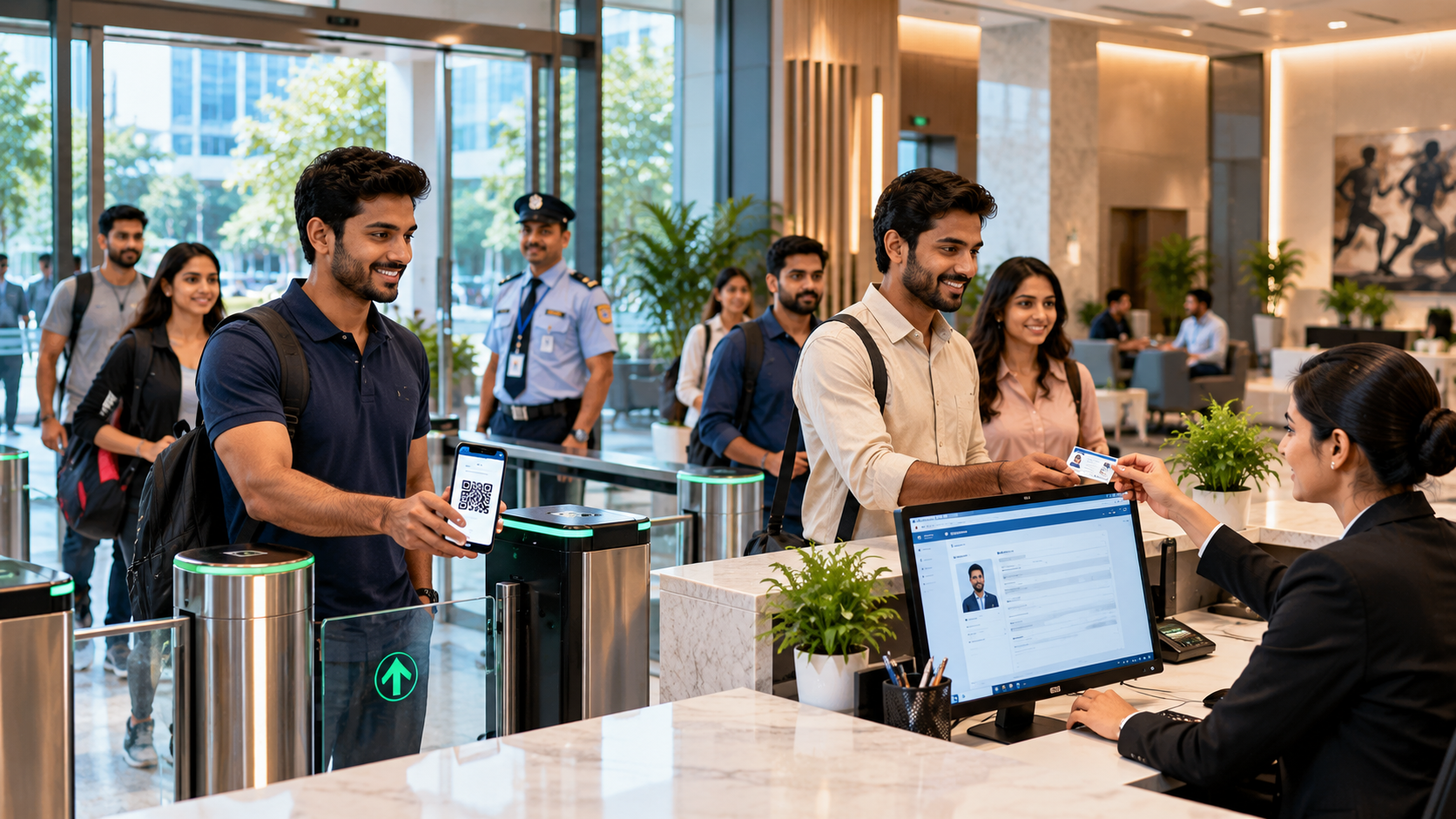
That kind of structure turns visitor handling from a weak point into a controlled workflow. It helps offices look more professional, schools stay more secure, and residential buildings manage daily movement with less confusion. Your uploaded product positioning already reflects this approach across offices, schools, residential societies, and other high-traffic environments.
Why More Organizations Are Moving Away From Manual Visitor Entry
Organizations do not switch because registers are old-fashioned.
They switch because the cost of manual handling becomes too visible.
The queues become embarrassing. The records become unreliable. The security gaps become harder to defend. Staff spend too much time on repetitive checks. Management gets limited visibility. Investigations take longer. Residents complain. Parents ask questions. Guests get delayed. Front-desk teams burn time on tasks that should be automated.
In other words, the old process starts creating pressure from every direction.
That is usually the turning point.
Final Thoughts
Visitor handling may begin at the gate, but its impact reaches much further.
It affects security, speed, control, records, user experience, emergency readiness, and organizational credibility. The biggest mistake many offices, schools, and residential buildings make is treating visitor entry as a small routine task instead of a critical operational process.
The most common visitor management challenges do not come from one dramatic failure. They come from repeated everyday weaknesses—manual entries, unclear approvals, poor recordkeeping, inconsistent checks, and limited real-time visibility.
Over time, those weaknesses become risk.
That is why organizations that want better control are moving toward structured digital visitor systems. When approvals are faster, logs are accurate, passes are traceable, and entry data is available in real time, the entire premises runs with more confidence.
For businesses and properties that want a practical solution, N&T Software positions its Visitor Management System around exactly these needs: automated gate passes, instant host approvals, real-time logs, analytics, QR-enabled pass validation, OTP-based entry, face recognition, notifications, and multi-location control for offices, schools, residential buildings, and other high-traffic environments.
The real value is not just digital entry.
The real value is knowing that every visitor movement is more controlled, more visible, and easier to manage.
FAQ Section
1. What are the most common visitor management challenges?
The most common visitor management challenges include long queues, manual record errors, weak approval workflows, poor visitor tracking, limited real-time visibility, and difficulty maintaining reliable audit trails.
2. Why is manual visitor entry a problem?
Manual visitor entry causes delays, incomplete records, verification gaps, and inconsistent gate decisions. It also makes it difficult to track who entered, who approved the visit, and whether the visitor has exited.
3. How do visitor management issues affect schools?
In schools, visitor management issues can affect student safety, gate discipline, parent handling, vendor access control, and the ability to maintain a reliable record of who is on campus.
4. Why do residential buildings need digital visitor management?
Residential buildings manage guests, deliveries, staff, technicians, and recurring service providers every day. A digital process helps improve approval accuracy, reduce gate confusion, and strengthen security without slowing entry.
5. How can offices improve visitor management?
Offices can improve visitor management by replacing manual logs with digital entry workflows, host approvals, smart visitor passes, instant notifications, and real-time tracking for better security and a better reception experience.
Still managing visitors through registers, calls, and inconsistent gate approvals? Upgrade to a smarter visitor management process with N&T Software. From offices and schools to residential buildings and gated communities, our Visitor Management System helps you reduce delays, improve security, and maintain real-time visitor control. Book a demo today.